
Limited Company vs Sole Trader: What’s the Difference and Which Is Better in 2026?
Choosing between operating as a sole trader and setting up a limited company is one of the first important decisions when starting a business in the UK. Both structures allow you to work independently, earn money and build a business, but they differ considerably in terms of legal responsibility, taxation, administration and how you can use your profits.
A sole trader operates as an individual, whereas a limited company is a separate legal entity. The right choice depends on your business income, financial responsibilities, future plans and how much administration you are prepared to manage.
Understanding the difference between a limited company and a sole trader can help you make a decision that supports your business now and as it grows.
In This Guide
What is a Sole Trader?
A sole trader is someone who owns and runs a business as an individual. You can work independently, employ staff and provide services to customers, but there is no legal separation between you and your business.
Registering as a sole trader is relatively straightforward. You generally need to register for Self Assessment with HM Revenue and Customs (HMRC), keep records of your business income and expenses, and submit an annual tax return.
One of the main advantages is that you retain all the profits after paying your business expenses and personal taxes. You also have direct control over business decisions without needing to follow company reporting requirements.
A sole trader structure is often suitable for freelancers, consultants, independent professionals and people starting small businesses who want a straightforward way to trade.
What is a Limited Company?
A limited company is a business registered with Companies House that has its own legal identity, separate from its owners and directors.
This means the company can enter into contracts, own assets, employ people and take responsibility for its own debts. Even if you are the only shareholder and director, the company remains legally separate from you.
To establish a limited company, you must register it with Companies House, appoint at least one director, provide the required company information and issue shares.
Unlike a sole trader, a limited company pays Corporation Tax on its taxable profits. Directors may receive a salary, while shareholders can receive dividends from available profits.
Limited companies also have ongoing reporting responsibilities, including annual accounts, Company Tax Returns and confirmation statements.
This structure is commonly used by growing businesses, contractors, consultants and entrepreneurs who want a formal business structure with limited liability.
Limited Company vs Sole Trader: Key Differences at a Glance
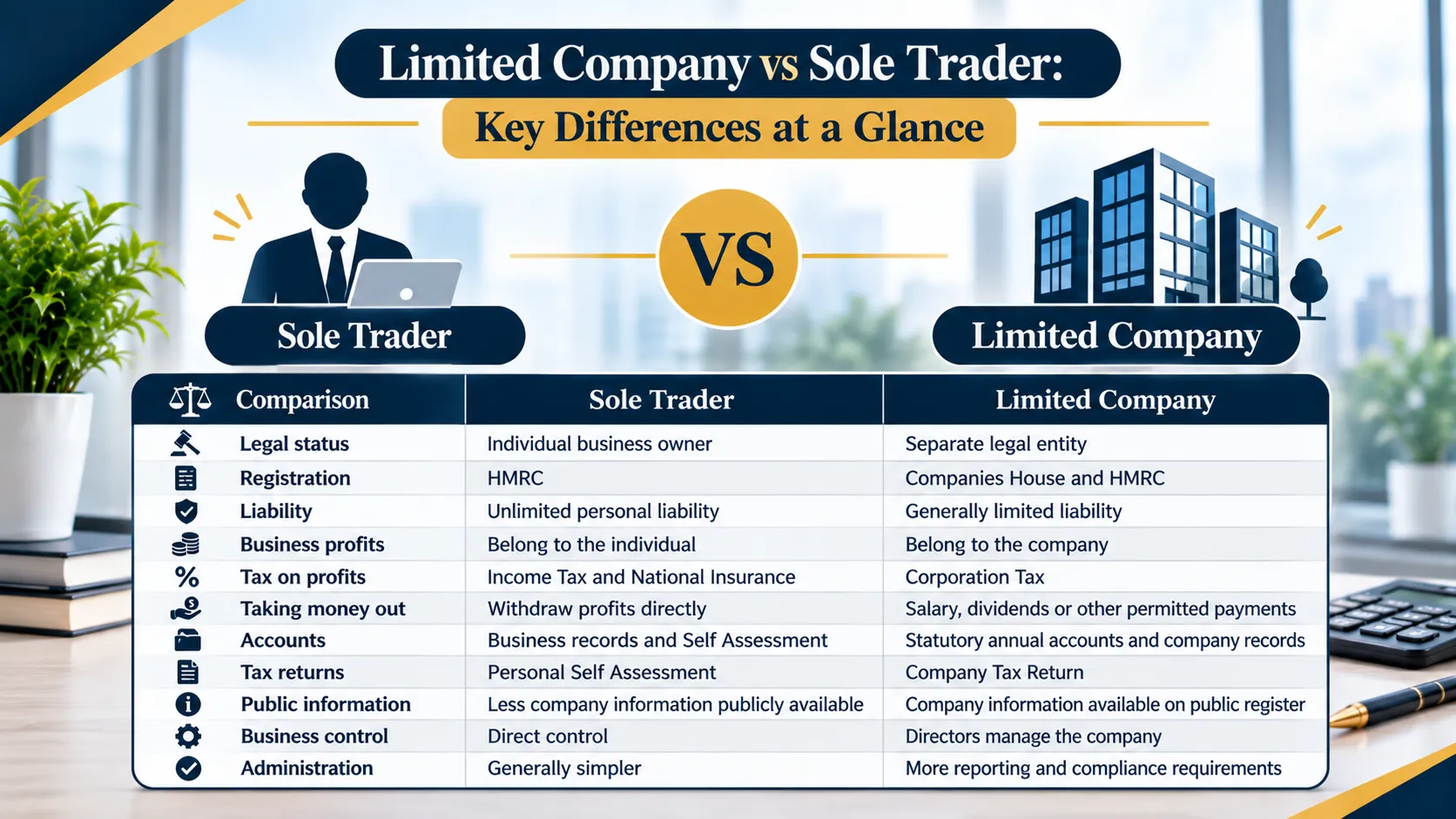
The following table highlights the main differences between these two business structures.
| Comparison | Sole Trader | Limited Company |
|---|---|---|
| Legal status | Individual business owner | Separate legal entity |
| Registration | HMRC (Self Assessment) | Companies House and HMRC |
| Liability | Unlimited personal liability | Generally limited liability |
| Business profits | Belong directly to the individual | Belong to the company |
| Tax on profits | Income Tax and National Insurance | Corporation Tax |
| Taking money out | Withdraw profits directly (drawings) | Salary, dividends or other permitted payments |
| Accounts | Business records and Self Assessment | Statutory annual accounts and company records |
| Tax returns | Personal Self Assessment (SA100) | Company Tax Return (CT600) |
| Public information | Less company information publicly available | Company information available on public register |
| Business control | Direct personal control | Directors manage the company on behalf of shareholders |
| Administration | Generally simpler | More reporting and compliance requirements |
Neither structure is automatically better. A sole trader arrangement offers simplicity, while a limited company provides a separate legal identity and different financial planning opportunities.
What Is the Difference in Tax Between a Sole Trader and a Limited Company?
Tax is often one of the biggest considerations when comparing a sole trader vs limited company. However, the most tax-efficient option depends on how much your business earns, your other income and how you take money out of the business.
Sole Trader Tax
As a sole trader, you pay Income Tax on your taxable business profits rather than your total turnover. You can deduct allowable business expenses before calculating your taxable profits.
For the 2026/27 tax year, the standard Income Tax rates in England, Wales and Northern Ireland are:
- Personal Allowance: £12,570 at 0%.
- Basic Rate: 20% (on income between £12,571 and £50,270).
- Higher Rate: 40% (on income between £50,271 and £125,140).
- Additional Rate: 45% (on income over £125,140).
You may also need to pay Class 4 National Insurance on your profits. For 2026/27, the rates are 6% on profits between £12,570 and £50,270, and 2% on profits above £50,270.
*Note: Scottish taxpayers have different Income Tax bands and rates.
Limited Company Tax
A limited company pays Corporation Tax on its taxable profits. For the 2026/27 financial year, the main rates are:
- 19% Small Profits Rate: for profits up to £50,000.
- 25% Main Rate: for profits above £250,000.
- Marginal Relief: for qualifying companies with profits between £50,000 and £250,000.
These thresholds can be affected by associated companies.
Directors can receive a salary through PAYE and may also receive dividends if the company has sufficient distributable profits. Dividends are not treated as a business expense when calculating Corporation Tax.
For 2026/27, dividend tax rates are 10.75% for basic-rate taxpayers, 35.75% for higher-rate taxpayers and 39.35% for additional-rate taxpayers, above the £500 dividend allowance.
The company may also have employer National Insurance responsibilities on directors' salaries.
So, which is more tax-efficient?
There is no universal answer. A limited company may offer useful tax-planning opportunities when some profits can remain in the business, but extracting all profits through salary and dividends can change the overall tax position.
The comparison should consider Corporation Tax, Income Tax, dividend tax and National Insurance together rather than looking at one tax rate in isolation.
Limited Liability vs Unlimited Liability: How are You Protected?
One of the most important legal differences between a sole trader and a limited company is personal financial responsibility.
As a sole trader, you and your business are legally the same. If your business has outstanding debts, suppliers or creditors may pursue your personal assets to recover the money.
A limited company generally provides limited liability to its shareholders. This means their financial responsibility is normally restricted to the amount they have invested or agreed to contribute towards their shares.
When Can Directors Still Face Personal Liability?
Limited liability does not mean directors can never be held personally responsible. Personal guarantees (often requested by commercial landlords or banks), wrongful trading, certain breaches of directors' duties and other legal circumstances can create personal liability.
For businesses with employees, significant contracts, borrowing or financial risks, this distinction deserves careful consideration.
Which Has More Administration and Running Costs?
A sole trader generally has fewer administrative responsibilities. You must maintain accurate business records, keep evidence of expenses and submit your Self Assessment tax return.
A limited company has additional reporting obligations, which commonly include:
Private limited companies normally have nine months after their financial year ends to file annual accounts, while Corporation Tax is generally payable nine months and one day after the accounting period ends.
Important 2026 Change: Making Tax Digital for Sole Traders
Making Tax Digital for Income Tax started on 6 April 2026 for eligible individuals with qualifying income above £50,000. The threshold reduces to £30,000 from April 2027 and £20,000 from April 2028.
This means some sole traders will need compatible software, digital records and quarterly updates to HMRC.
In terms of running costs, sole traders generally spend less on accounting and compliance because their reporting requirements are simpler. Limited companies may have higher accountancy fees due to additional accounts, Corporation Tax and payroll responsibilities.
Both structures may also need to register for VAT when their taxable turnover exceeds the applicable £90,000 threshold. VAT registration is not determined by whether you are a sole trader or a limited company.
Sole Trader or Limited Company: Which Is Better for Contractors and Freelancers?
For contractors and freelancers, choosing a business structure involves more than comparing tax rates.
Working as a sole trader can be suitable for independent professionals who provide services directly to clients and want to keep their business arrangements straightforward.
A limited company may be more appropriate for contractors who work with agencies, larger organisations or clients that prefer to engage incorporated businesses.
Freelancers should also consider their expected earnings, professional risks, client requirements and plans for future growth before deciding.
Getting advice from specialist contractor accountants in Bristol can help you understand the financial and compliance implications of each structure.
When Should You Switch from Sole Trader to Limited Company?
There is no fixed income level at which every sole trader should become a limited company. The right time depends on business circumstances rather than a single turnover or profit figure.
You may want to consider incorporating when:
Switching from sole trader to limited company involves more than registering a new business. You may need to transfer business assets, contracts, equipment, stock and other responsibilities into the company.
You should also consider VAT registration, tax implications, outstanding liabilities and the correct treatment of business income during the transition.
Professional advice can help you plan the change properly and avoid unnecessary tax or administrative complications.
Final Thoughts
The difference between a limited company and a sole trader comes down to legal responsibility, taxation, administration and how you want to manage your business.
A sole trader structure can be a practical starting point for individuals who value simplicity and direct control. A limited company may be more suitable for businesses looking for a separate legal identity, limited liability and opportunities to retain profits for future growth.
Before making a decision, consider your expected profits, personal financial circumstances, business risks and long-term objectives.
At Henleaze Tax Consultancy, we help individuals, freelancers, contractors and small businesses understand their tax responsibilities and choose suitable accounting arrangements. Whether you are starting as a sole trader, considering incorporation or looking for ongoing accounting support, our team can help you make informed financial decisions.
Unsure whether to incorporate or stay a sole trader?
We'll evaluate your turnover, expenses, IR35 position and extraction plans to calculate the most tax-efficient route for your business.