
How to Choose a Contractor Accountant in UK: 9 Key Factors Every UK Contractor Should Consider
Choosing the right contractor accountant is about more than comparing fees. A specialist contractor accountant can help you manage your tax obligations, stay compliant with HMRC, navigate IR35 and maximise your take-home income. However, not every accountant has the expertise or services that contractors need.
This guide outlines the 9 key factors to consider when choosing a contractor accountant, helping you make an informed decision and find the right support for your business.
In This Article
When Should You Hire a Contractor Accountant?
The short answer is before you start contracting — not after your first invoice has gone out.
Getting the right structure in place from day one means your limited company is set up correctly, your salary and VAT position is sorted from the outset and you are not paying to unpick early mistakes later. Most specialist contractor accountants will help you form your limited company as part of onboarding, so there is no reason to delay. Many contractor accounting firms also provide ongoing contractor accounting services, including payroll, VAT returns and tax planning, making it easier to manage your business from day one.
If you are already contracting and using a generalist accountant or doing your own books, it is never too late to switch to a specialist. The process is straightforward and a good firm will handle the transition for you.
9 Key Factors to Consider When Choosing a Contractor Accountant
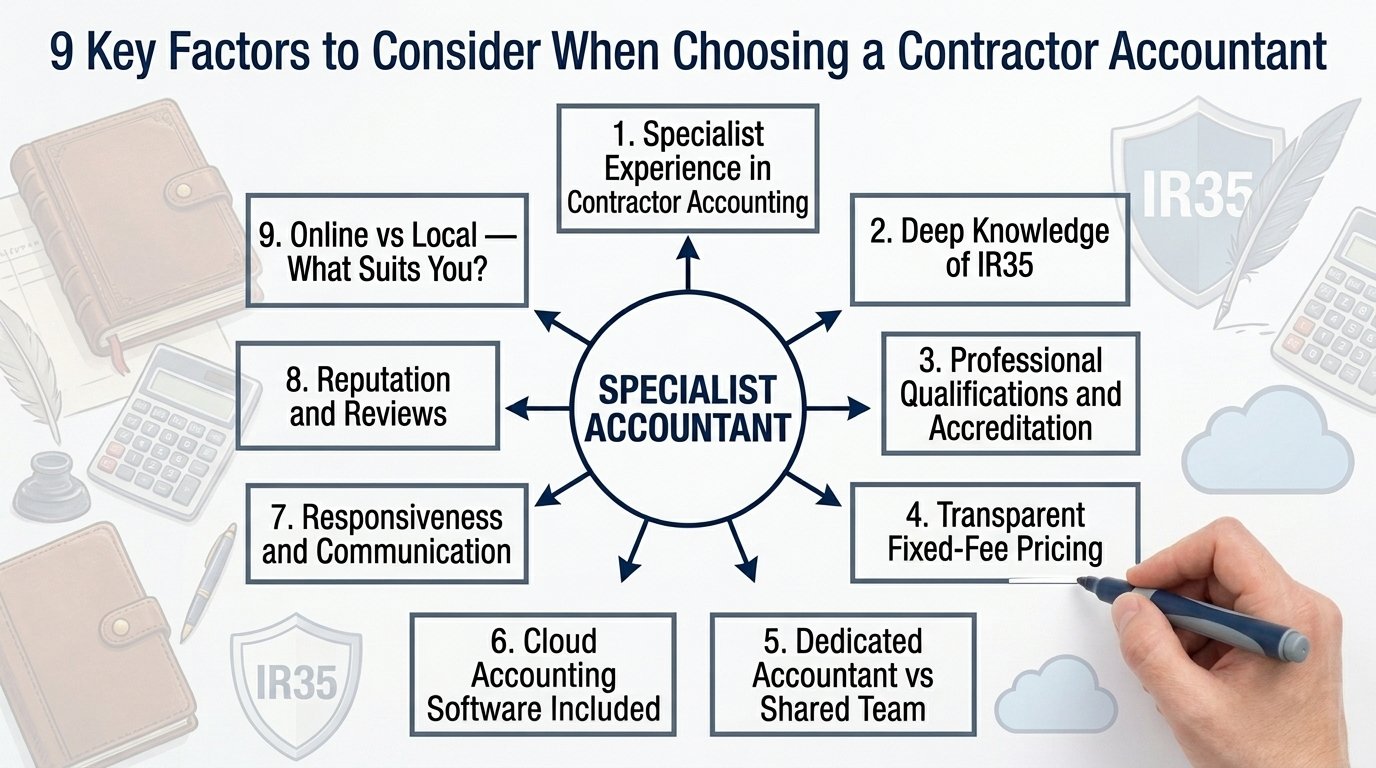
1. Specialist Experience in Contractor Accounting
This is the most important factor of all. Not every accountant who says they work with contractors actually specialises in it. There is a significant difference between a firm that handles a handful of contractor clients alongside shops and sole traders and one where limited company contractors make up the majority of their client base.
A genuine specialist will understand IR35, PSC structures, salary and dividend planning, and off-payroll working rules as everyday matters, not as occasional topics they need to look up. Before signing up, ask directly: what percentage of your clients are limited company contractors?
2. Deep Knowledge of IR35
IR35 is the single biggest financial risk most UK contractors face and your accountant must have a thorough, up-to-date understanding of it, not just a passing familiarity.
A strong contractor accountant will:
- Review your contracts against IR35 criteria before you sign them
- Advise on your working practices to help maintain outside IR35 status
- Explain clearly what inside IR35 means for your take-home pay
- Know how the off-payroll working rules apply in both the public and private sector
- Represent you if HMRC opens a compliance enquiry
For more on why this matters, see our guide: why do contractors need a specialist accountant in the UK?
3. Professional Qualifications and Accreditation
A qualified accountant is not just a nice-to-have, it is essential. Look for accountants who hold recognised professional qualifications:
- ACCA (Association of Chartered Certified Accountants)
- ACA / ICAEW (Institute of Chartered Accountants in England and Wales)
- AAT (Association of Accounting Technicians) — acceptable at junior level
For contractor specialists specifically, FCSA accreditation (Freelancer and Contractor Services Association) is a strong additional signal. FCSA members undergo independent audits to verify compliance and professional standards, it is one of the most credible marks of quality in the contractor accounting space.
You can verify an accountant's credentials directly through the ACCA directory.
4. Transparent Fixed-Fee Pricing
Most reputable contractor accountants charge a fixed monthly fee and this is the model that works best for contractors. You know exactly what you are paying each month, with no surprise invoices at year end or extra charges for routine queries.
What to look for:
- A clear written breakdown of what is included in the monthly fee
- Confirmation of what is charged as an extra (IR35 reviews, mortgage letters, additional payroll)
- Whether VAT is included in the quoted price or charged on top
- No long minimum contract periods that lock you in unnecessarily
If a firm is vague about pricing during the sales process, that is a warning sign. For a full breakdown of what contractor accountant fees typically cover, see our guide: how much does a contractor accountant cost in the UK?
5. Dedicated Accountant vs Shared Team
Some firms assign you a single named accountant who gets to know your business. Others operate a shared team model where you deal with whoever picks up your query on any given day.
Neither model is automatically wrong, but for contractors, particularly those with complex tax situations, IR35 considerations or multiple income streams — having a dedicated point of contact makes a real difference. Your accountant should know your contracts, your working arrangements and your financial goals without you having to explain them from scratch every time you call.
Ask before signing up: will I have a named accountant and what happens if they are unavailable?
6. Cloud Accounting Software Included
A good contractor accountant will use market-standard cloud accounting software, typically FreeAgent, Xero or QuickBooks. These platforms give you real-time visibility of your finances, easy mobile expense tracking, automated VAT return preparation and instant access to key figures like your corporation tax liability.
A few things worth checking:
- Is the software licence included in the monthly fee or charged separately?
- Does the firm use their own proprietary platform? If so, be cautious — proprietary systems have historically had more security vulnerabilities than established providers and make it harder to switch accountants later
- Can you access your own data easily if you decide to move to a different firm?
7. Responsiveness and Communication
An accountant who is slow to respond is more than just frustrating, it can lead to missed deadlines, late filings and HMRC penalties. Responsiveness matters most when it matters most: around the January Self Assessment deadline, quarterly VAT return dates and any time HMRC gets in touch.
Before committing to a firm, ask:
- What is your typical response time for client queries?
- Do I contact you directly by phone and email, or through a ticketing system?
- What happens around busy periods like January — do response times change?
How a firm handles your questions before you become a client is usually a good indicator of how they will handle them after.
8. Reputation and Reviews
A professional website and a well-written brochure tell you very little about what it is actually like to work with a firm. Reviews from real contractors do.
Check the following:
- Google Reviews — look for volume and consistency, not just the star rating
- Trustpilot — useful for spotting patterns in how complaints are handled
- ContractorUK forums — one of the most honest sources of contractor feedback in the UK
- Personal recommendations — ask fellow contractors who they use and whether they would recommend them
Look beyond the headline rating. A firm with 200 reviews averaging 4.6 stars tells you more than one with 8 reviews averaging 5.0. It can also be useful to compare the top 10 accounting firms in the UK when researching reputable providers.
9. Online vs Local — What Suits You?
Most contractor accountants in the UK now operate primarily online and for the majority of contractors this works perfectly well. Online-only firms tend to have lower overheads and pass some of that savings on through their pricing. Communication happens via email, phone and video call and cloud software means your records are always accessible.
That said, some contractors prefer face-to-face contact — particularly when dealing with more complex matters like IR35 disputes, tax planning or significant business changes. If that applies to you, a local specialist firm is worth considering.
For Bristol-based contractors, working with a local firm means your accountant understands the local contractor market, is available to meet in person when needed and is easy to reach without relying entirely on digital communication.
For a full breakdown of what specialist contractor accountants offer, see our guide: What services do contractor accountants provide in the UK?
Why Bristol Contractors Choose Henleaze Tax Consultancy
Bristol has a growing and active contracting community across technology, engineering and the creative industries. At Henleaze Tax Consultancy, we work exclusively with contractors, freelancers and limited company directors — so everything we do is built around the way contractors actually work.
We offer fixed monthly fees with no hidden extras, a dedicated accountant for every client, genuine IR35 expertise and face-to-face availability for Bristol-based clients who prefer it. We use FreeAgent as standard, included in your monthly fee and we are happy to handle the transition from your current accountant without any disruption to your business.
If you're comparing local providers, our guide to the top 5 accountancy firms in Bristol can help you assess the options available.
Book a free consultation
Talk to a specialist contractor accountant today. No pressure, no jargon — just straightforward advice.
Final Words
Choosing the right contractor accountant is one of the most impactful decisions you will make as a limited company contractor. The difference between a generalist and a genuine specialist can mean thousands of pounds in tax savings, proper IR35 protection and the peace of mind that comes from knowing everything is being handled correctly.
Take your time, ask the right questions and do not choose based on price alone. The right firm will cost less than you think — and save you far more than their fee.
For contractors who need broader tax support, comparing tax advisory firms in Bristol can also help when choosing the right professional.
Locations We Cover Across the UK
Providing proactive accounting, tax planning, and payroll support to businesses, landlords, and contractors across the UK.