

IR35 Rules 2026: What Every UK Contractor Must Know
From thresholds to record-keeping, here are the IR35 rules that actually apply to you in 2026 and what happens if a client gets one wrong.
In This Article
The IR35 rules require anyone contracting through a limited company to be taxed as an employee if their actual working relationship looks like employment — and they set out exactly who must assess that, when, and what happens if they get it wrong. In 2026, the rules that matter most are the raised small company thresholds, a contractor's right to request their client's size classification, a ban on blanket status decisions, and clear obligations around record-keeping.
This guide covers each one directly, so you know exactly where you stand and what's legally required of you or your client.
What Are the IR35 Rules?
At their core, the rules split responsibility for determining IR35 status by the size of the client, require that determination to reflect real working practices rather than just the contract, and give contractors the right to challenge a decision they believe is wrong. Since April 2026, the thresholds defining a "small" client have risen, shifting responsibility back to thousands of contractors' own companies.
We'll go through each rule in turn below.
Who the IR35 Rules Apply To
The rules apply to anyone providing services to a client through an intermediary — most commonly their own limited company (a personal service company, or PSC) — where the way they actually work would otherwise look like employment. They don't apply to genuine sole traders working outside a limited company structure, or to agency workers already taxed under PAYE.
If you invoice through your own company for contract work, the rules apply to you regardless of your sector or day rate.
When the Rules Apply in the Private and Public Sectors
Compliance requirements depend on both the client's sector and its size.
For public sector clients and medium or large private or voluntary sector clients, the client is responsible for determining whether the off-payroll rules apply and must give the contractor a written determination along with the reasoning behind it. If the engagement is inside IR35, the fee-payer deducts Income Tax and NIC before paying the contractor. A contractor who disagrees can raise it before their final payment; the client then has up to 45 days to respond, continuing to pay based on the original determination in the meantime, before confirming or revising the decision.
A private or voluntary sector organisation counts as medium or large if it meets two or more of: annual turnover above £15 million, a balance sheet total above £7.5 million, or more than 50 employees. Below that, it's classed as small.
For small private or voluntary sector clients, the rules work differently — responsibility shifts to the contractor's own company to decide whether the rules apply. The client simply pays the intermediary, the intermediary pays the contractor, and if the rules apply, the intermediary is responsible for handling the Income Tax and NIC due to HMRC.
Public sector rules have applied since 2017; private and voluntary sector rules followed in April 2021, with the size thresholds updated most recently in April 2026.
Rule 1: Who Determines Your IR35 Status
This comes down to client size and sector — medium/large or public sector clients determine status themselves, while small private and voluntary sector clients leave that responsibility with the contractor's own company. This single rule is the one that changes most often as thresholds are updated, so it's worth checking your client's current classification annually rather than assuming it hasn't shifted.
For the full mechanics of how a determination actually gets made and communicated, see our guide on how IR35 works.
Rule 2: The 2026 Small Company Thresholds
From 6 April 2026, the thresholds increased:
| Criteria | Old threshold | New threshold |
|---|---|---|
| Turnover | £10.2 million | £15 million |
| Balance sheet total | £5.1 million | £7.5 million |
| Employees | 50 | 50 (unchanged) |
Because these assessments rely on a client's accounts from the previous financial year, the practical effect for many contractors is only showing up on engagements starting around now, even though the thresholds technically took effect earlier. HMRC estimates roughly 14,000 businesses have moved from medium to small as a result, shifting IR35 responsibility back to the contractor's own company on those engagements.
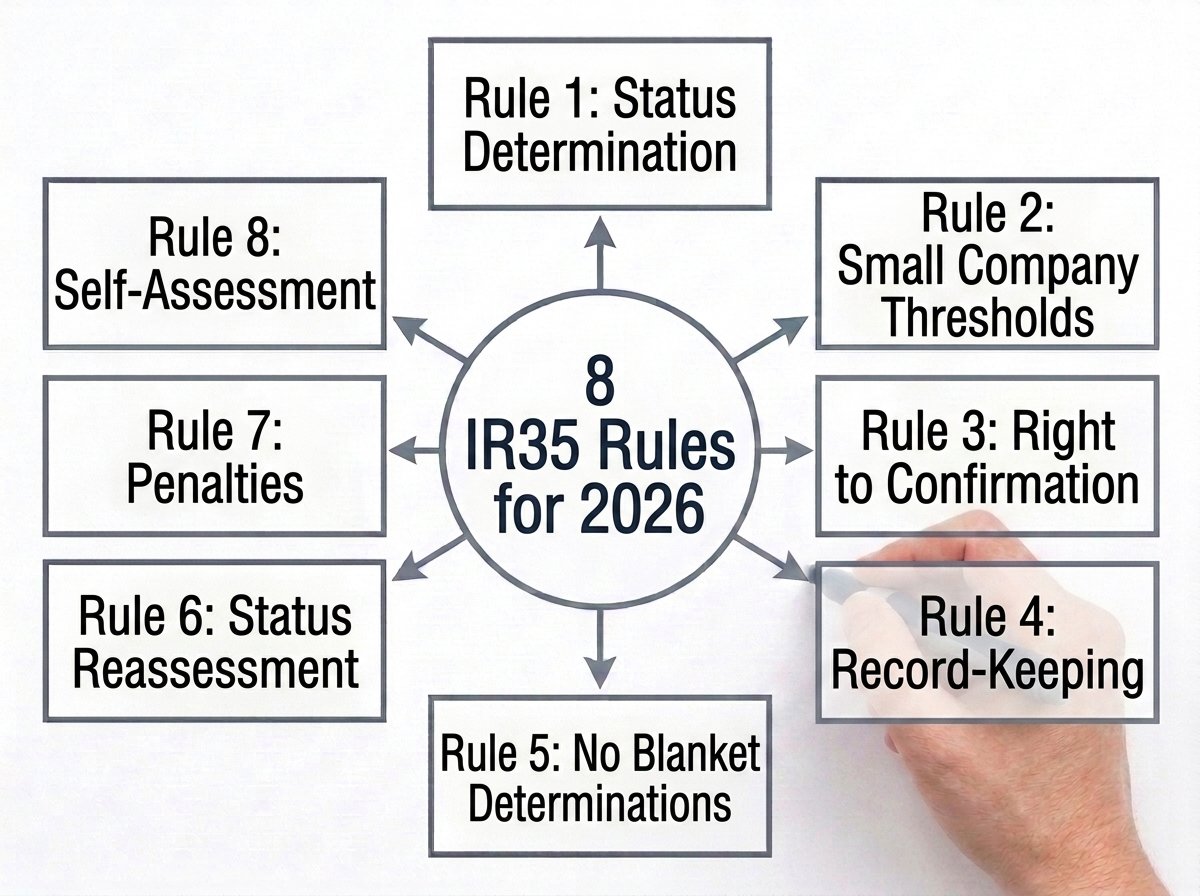
Rule 3: Your Right to Request Company Size Confirmation
If you're unsure whether your client now counts as small, you're entitled to formally request confirmation from them — and they must respond within 45 days. This is a genuinely underused right: many contractors simply assume their client's status hasn't changed, when the 2026 threshold rise means a meaningful number actually have.
If a client goes quiet or refuses to confirm, that's worth flagging to a contractor accountant, since it directly affects who's responsible for your determination.
Rule 4: Record-Keeping Obligations for Contractors and Clients
Both sides carry documentation duties. Clients must keep a record of each status determination and the reasoning behind it. Contractors should keep evidence of their actual working practices — correspondence, invoices, evidence of substitution rights being used, and anything else showing how the engagement really operates day to day.
This matters most if HMRC ever investigates, since a determination without supporting evidence is far weaker than one backed by a clear paper trail on both sides.
Rule 5: Blanket Determinations Are Not Allowed
A client cannot lawfully assess every contractor in a similar role as automatically inside or outside IR35 without looking at each engagement individually. In practice, some clients still do this to manage risk — particularly around blanket "inside" decisions — but it doesn't hold up if challenged.
Each contractor's actual working practices have to be assessed on their own terms.
Rule 6: Status Must Be Reassessed When Working Practices Change
An IR35 determination reflects the relationship as it stands, not a fixed decision for the life of the contract. If your role changes meaningfully — more supervision, a different scope, loss of a substitution right — the determination should be revisited rather than left as originally issued.
Relying on an outdated determination when working practices have shifted is one of the more common causes of unexpected IR35 exposure.
Rule 7: Penalties for Getting It Wrong
Getting a determination wrong can mean backdated Income Tax and NIC, interest, and penalties — and in cases of deliberate non-compliance, HMRC can look back as far as 20 years. Who's liable depends on where the error occurred: the client if they made an unreasonable determination, or the fee-payer if PAYE wasn't operated correctly once a determination was made.
This is exactly why the record-keeping in Rule 4 matters so much in practice.
Rule 8: Self-Assessment Obligations for Small Company Clients
If your client is small, the obligation to assess your own status doesn't disappear just because nobody's chasing you for it. You're expected to reach a genuine, evidenced conclusion and pay the correct tax accordingly.
Getting this wrong carries the same financial risk as a client getting it wrong — just with the liability sitting with your own company instead.
IR35 Compliance Checklist for Contractors
- 1Check your client's current size classification each tax year, and request confirmation if you're unsure
- 2Keep a written record of your actual working practices, not just your contract
- 3Review your IR35 status if your role or working pattern changes mid-contract
- 4Don't rely on CEST alone for anything borderline — see our full breakdown of inside vs outside IR35 for what's at stake either way.
- 5Get a professional review before signing a long-term or high-value contract
How a Contractor Accountant Keeps You Compliant
Keeping up with which rules apply to you and when is easier with a specialist contractor accountant tracking it on your behalf — checking your client's classification each year, reviewing your contract against current requirements, and making sure your own records would hold up if HMRC ever asked.
Given the penalties involved in getting any of this wrong, it's generally worth building into your annual routine rather than checking only when something feels uncertain. See our contractor accountant services for how we support this.
This guide reflects UK off-payroll working rules as they stood in July 2026. For a decision involving significant money, get a professional status review from a qualified contractor accountant rather than relying on any single article.
Need professional IR35 advice?
Our specialist accountants review your contracts and working arrangements to ensure full IR35 compliance in 2026.
Frequently Asked Questions
Locations We Cover Across the UK
Providing proactive accounting, tax planning, and payroll support to businesses, landlords, and contractors across the UK.