

Salary vs Dividends in the UK: Which Is More Tax Efficient in 2027?
Choosing how to take money from a limited company is an important decision for directors. Two common ways to receive income are through a salary or dividends. Although both allow you to take money from your business, they are treated differently for tax purposes.
A salary is paid through the company's payroll and may be subject to Income Tax and National Insurance. Dividends are payments made to shareholders from the company's available profits. They have different tax rules and cannot be treated as a business expense.
For many company directors, using a combination of salary and dividends may be worth considering. However, the most suitable approach depends on company profits, personal income and other financial circumstances. This guide explains the differences, how each option is taxed and what to consider before deciding how to pay yourself.
In This Guide
What is the Difference Between Salary and Dividends?
The main difference is that a salary is payment for work carried out as a director or employee, while a dividend is a distribution of company profits to shareholders. Both can provide income to a company director, but the eligibility requirements and tax treatment are different.
What is a Director's Salary?
A director's salary is payment made by a limited company for the work and responsibilities carried out by its director. It is normally processed through the company's Pay As You Earn (PAYE) payroll system, just like wages paid to other employees.
When a company pays a director a salary, it must account for Income Tax and National Insurance where applicable. The company may also have to pay employer's National Insurance. Salary payments and relevant deductions must be reported to HMRC.
A salary is generally an allowable business expense when calculating taxable company profits, provided the normal tax requirements are met. This can reduce the profits on which Corporation Tax is calculated.
What are Dividends?
Dividends are payments a limited company makes to its shareholders from profits available for distribution. Unlike a salary, a dividend is not payment for carrying out work. It is a return received from owning shares in the company.
A director can receive dividends if they also own shares and the company has sufficient distributable profits. Having money in the business bank account does not automatically mean the company can pay dividends. It must have enough available profits after accounting for relevant losses and liabilities.
Dividends are not processed through PAYE and do not attract National Insurance contributions. However, shareholders may need to pay personal dividend tax if their dividend income exceeds the available allowances.
Companies must also follow the correct procedures when declaring dividends. This normally includes recording the decision and preparing a dividend voucher for each payment.
Salary vs Dividends: Key Differences at a Glance
Salary and dividends both provide ways for a company director to receive money from a limited company. However, they differ in how they are paid, who can receive them and how they affect the company's tax position.
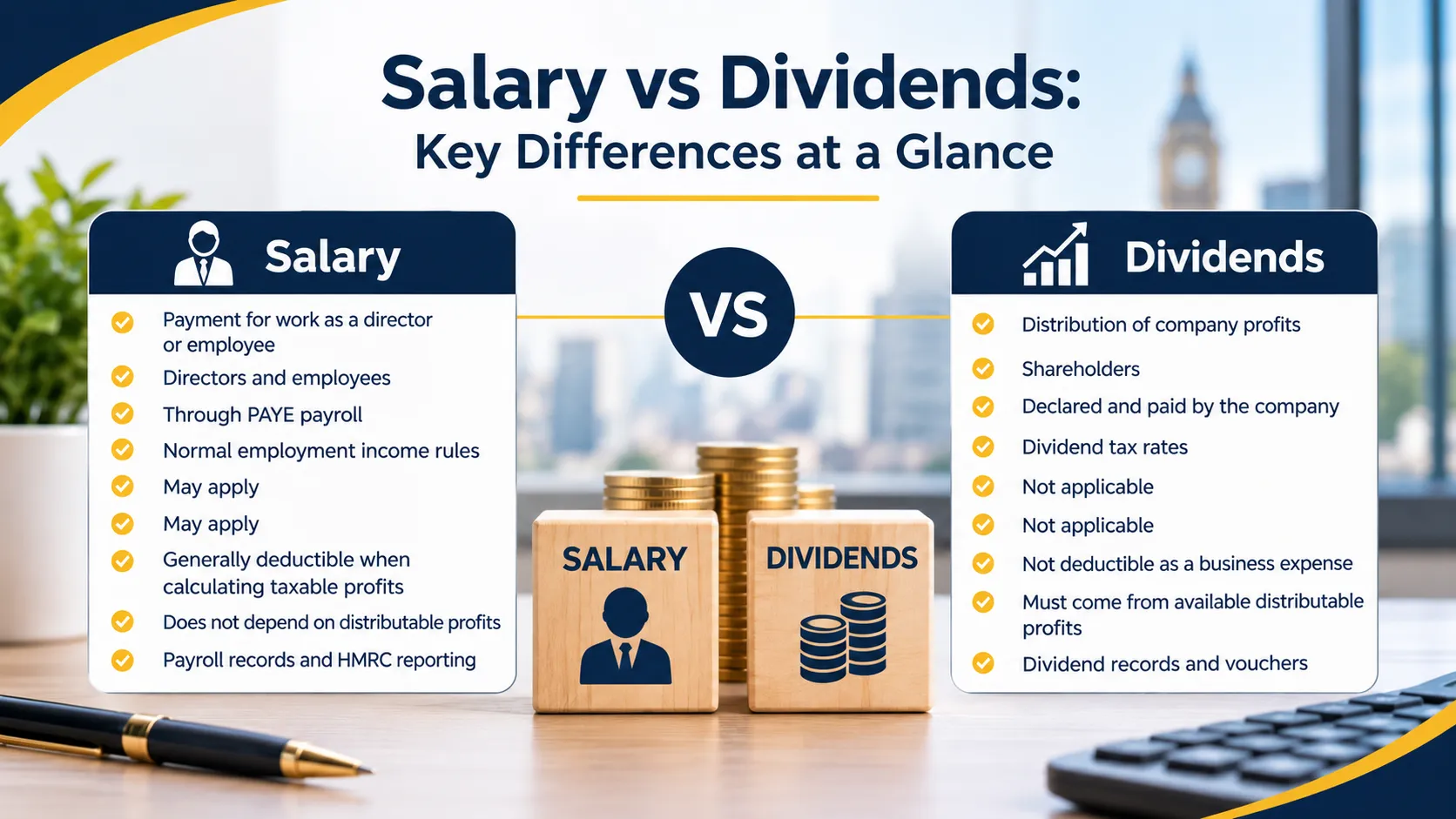
| Comparison | Salary | Dividends |
|---|---|---|
| What it means | Payment for work as a director or employee | Distribution of company profits to shareholders |
| Who can receive it | Directors and employees | Shareholders only |
| Payment method | Processed through PAYE payroll | Declared by board resolution & paid by the company |
| Income Tax | Normal employment income tax bands (20%, 40%, 45%) | Dividend tax rates (10.75%, 35.75%, 39.35%) |
| Employee National Insurance | May apply on earnings above thresholds | Not applicable (0% NICs) |
| Employer National Insurance | May apply to the company on earnings above thresholds | Not applicable (0% NICs) |
| Corporation Tax | Generally deductible as an allowable business expense | Not deductible (paid from post-Corporation Tax profits) |
| Profit requirement | Does not depend on distributable profits | Must come strictly from available distributable profits |
| Records required | Payroll records, payslips and RTI HMRC reporting | Board minutes, dividend records and dividend vouchers |
How is a Director's Salary Taxed in the UK?
A director's salary is treated as employment income, meaning it is subject to the normal Income Tax and National Insurance rules. The amount payable depends on the director's total taxable income, available allowances and applicable thresholds.
Income Tax on Salary
Salary is added to a person's other taxable income when calculating their Income Tax liability. The Personal Allowance determines how much income an individual can receive before paying Income Tax, although it can be reduced for people with higher incomes.
The amount of tax payable depends on the individual's tax band. Other income, such as earnings from another job or rental income, may affect the calculation.
Employee and Employer National Insurance
National Insurance is another important consideration when deciding how much salary to take. Directors may have to pay employee National Insurance on earnings above the relevant threshold, while the company may also be responsible for employer contributions.
Directors have specific National Insurance calculation rules. Their contributions are generally calculated using annual earnings rather than simply treating each monthly payment as a separate calculation. This is particularly relevant when directors receive irregular salaries or bonuses.
The company should use suitable payroll software or professional payroll support to calculate and report the correct amounts.
How Salary Affects Corporation Tax
A genuine salary paid for work carried out by a director is generally an allowable expense when calculating the company's taxable profits. This means it can reduce the amount of profit subject to Corporation Tax.
However, the company must account for the associated payroll costs, including employer National Insurance where applicable. Therefore, directors should consider the overall cost to the company rather than looking only at their personal Income Tax.
How are Dividends Taxed in the UK?
Dividends are taxed differently from salary because they are distributions of company profits rather than employment payments. Shareholders may have to pay personal dividend tax, but dividends do not attract employee or employer National Insurance.
Dividend Allowance and Tax Rates
Individuals receive a dividend allowance, which is currently £500. Dividend income within this allowance is not subject to dividend tax. Any amount above it is taxed according to the individual's applicable Income Tax band.
The current dividend tax rates are:
| Tax band | Dividend tax rate |
|---|---|
| Basic rate | 10.75% |
| Higher rate | 35.75% |
| Additional rate | 39.35% |
These rates apply to dividend income above the available allowance. The individual's total income determines which tax band applies, so other earnings must also be considered.
Why Dividends Do Not Reduce Corporation Tax
Unlike salary, dividends cannot be deducted as a business expense when calculating Corporation Tax. The company pays Corporation Tax on its taxable profits before distributing available profits to shareholders.
This distinction is important. Although dividends may have a different personal tax treatment, they are not automatically more tax efficient once company-level taxes are included.
Is It Better to Take a Salary or Dividends?
There is no single answer for every company director. The better option depends on the company's financial position, the director's personal tax circumstances and the overall cost of each payment method.
When Taking a Salary May Be Suitable
A salary may be appropriate when a director wants regular income from the company. It can also help build a National Insurance record, which may contribute towards State Pension entitlement, depending on the level of earnings and individual circumstances.
Salary payments can also count towards pension arrangements and provide a formal employment income record. However, employer National Insurance and payroll administration should be included when assessing the cost.
When Dividends May Be Suitable
Dividends may be appropriate when a director is also a shareholder and the company has sufficient distributable profits. They do not attract National Insurance, which can make them attractive in certain circumstances.
However, dividends are not guaranteed income. A company cannot pay them simply because a director wants to withdraw money. The necessary profits and company procedures must be in place.
Why Many Directors Combine Salary and Dividends
Many owner-managed businesses consider a combination of salary and dividends rather than relying entirely on one method. A salary can provide regular earnings, while dividends can provide additional income when the company has sufficient profits.
The right balance requires a calculation of personal Income Tax, National Insurance, employer costs and Corporation Tax. It should also take account of other income and the director's longer-term financial plans.
Salary vs Dividends: A Practical Example
Consider a director who owns shares in a profitable limited company and wants to withdraw money for personal use. They could receive a salary, take dividends or use a combination of both.
If the director takes everything as salary, the company must operate payroll and consider employee and employer National Insurance. The salary may reduce taxable company profits, but the overall employment costs need to be assessed.
If the director takes dividends, the company must first have sufficient distributable profits and account for Corporation Tax. The shareholder may then have personal dividend tax to pay, depending on their total income and available allowance.
A combination may provide a more suitable balance, but the outcome depends on the figures. An accountant can compare the total company and personal tax costs before recommending an approach.
How Can an Accountant Help With Salary and Dividend Planning?
An accountant can help company directors choose a suitable way to receive income while keeping their tax and reporting responsibilities in order. Rather than relying on a general salary or dividend recommendation, they can assess the company's profits and the director's personal circumstances.
Support may include:
At Henleaze Tax Consultancy, we support contractors, freelancers, limited company directors and small businesses with payroll, bookkeeping, tax planning and accounting services. Our team can help you understand your options and manage your company's financial responsibilities.
Final Words
Choosing between salary and dividends is an important part of managing a limited company. While each method has different tax advantages and responsibilities, the most suitable option depends on the company's profits and the director's personal circumstances.
A carefully planned combination can help directors manage their income while keeping the company compliant. If you need help with payroll, tax planning or company accounting, Henleaze Tax Consultancy can provide professional support to help you make informed decisions.
Need tailored advice on your director salary & dividends?
We'll review your company profits, personal tax bands, Corporation Tax and extraction goals to build a bespoke remuneration model.