
HMRC Mileage Rates 2026/27: Updated Rates, Rules and Examples
Check the latest HMRC mileage rates for cars, vans, motorcycles and bicycles. Learn who can claim, how the rates work and which journeys qualify.
The HMRC mileage rate for cars and vans increased from 45p to 55p per mile for the first 10,000 business miles from 6 April 2026. The rate drops to 25p for each additional mile. Motorcycles qualify for 24p per mile, while bicycles qualify for 20p per mile under the employee mileage allowance rules.
The increase was announced in May 2026 and applies retrospectively from the beginning of the tax year. It is the first increase to the main car and van rate since 2011.
These rates help employees, employers and eligible self-employed people calculate business mileage expenses. However, the rules differ depending on whether you use your own vehicle as an employee, operate as a sole trader or run a limited company.
"This guide explains the current rates, worked examples, eligible journeys, tax relief and record-keeping requirements, including what contractors and company directors need to consider."
In This Article
What are the Current HMRC Mileage Rates?
HMRC publishes approved mileage rates for people using their own vehicles for business travel. The applicable rate depends on the vehicle type and, for cars and vans, the number of business miles covered during the tax year.
| Vehicle | Business mileage | Rate per mile |
|---|---|---|
| Car or van | First 10,000 miles | 55p |
| Car or van | Above 10,000 miles | 25p |
| Motorcycle | All business miles | 24p |
| Bicycle | All business miles | 20p |
| Passenger supplement | Each eligible fellow employee carried in a car or van | 5p |
The rates above apply for the tax year running from 6 April 2026 to 5 April 2027. The passenger supplement is separate from the driver's mileage allowance and applies when the relevant conditions are met.
The increase to the car and van rate is confirmed in HMRC's official mileage allowance guidance. The lower car and van rate, along with the motorcycle and bicycle rates, remains unchanged.
These figures are not a compulsory reimbursement amount for every employer. Employers can choose their own reimbursement rates, but tax treatment depends on how much they pay and the applicable HMRC rules.
How Does the 10,000-Mile Threshold Work?
The higher car and van rate applies to the first 10,000 qualifying business miles in the tax year. Each additional mile is calculated at 25p.
For example, if you drive 12,000 qualifying business miles in your own car, the calculation is:
| Calculation | Amount |
|---|---|
| First 10,000 miles × 55p | £5,500 |
| Remaining 2,000 miles × 25p | £500 |
| Total approved amount | £6,000 |
For 8,000 business miles, the calculation is 8,000 × 55p, giving £4,400.
- The threshold relates to business mileage, not your total annual driving. Personal journeys and ordinary commuting should not be included in a business mileage claim.
- For employee mileage allowance payments, the tax calculation uses the first 10,000 business miles and the subsequent-mile rate. Employers should also apply the separate National Insurance rules where relevant.
HMRC Mileage Rates: Previous vs Current
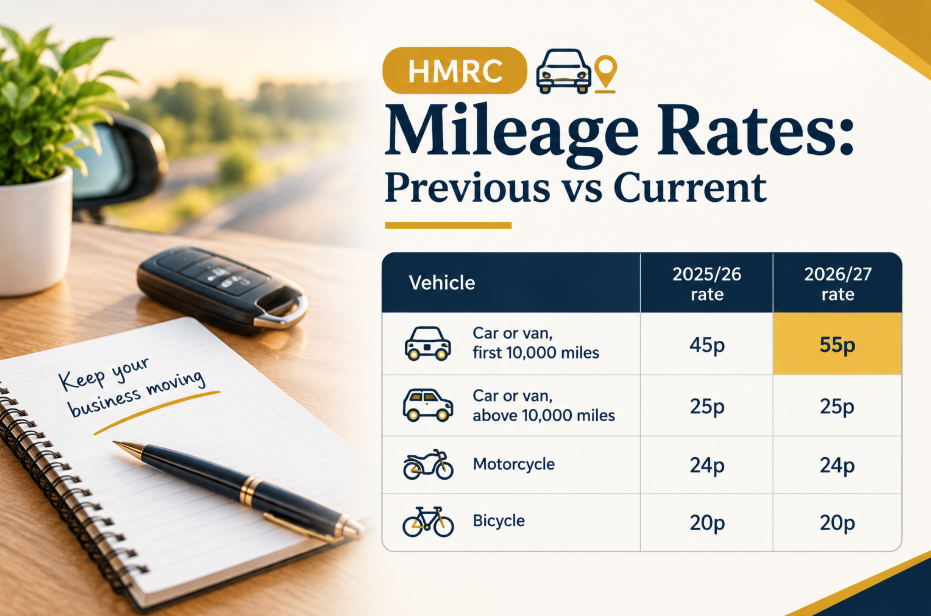
The main change is the increase in the first-tier car and van rate. The other rates have remained the same.
| Vehicle | 2025/26 rate | 2026/27 rate |
|---|---|---|
| Car or van, first 10,000 miles | 45p | 55p |
| Car or van, above 10,000 miles | 25p | 25p |
| Motorcycle | 24p | 24p |
| Bicycle | 20p | 20p |
The previous 45p rate applied to eligible journeys made before 6 April 2026. The new 55p rate applies retrospectively from that date, so eligible journeys made earlier in the current tax year are included.
For someone covering 10,000 qualifying business miles in a car or van, the difference between the old and new first-tier rates is £1,000. For mileage above that threshold, the additional miles continue to be calculated at 25p.
The government has also said it will review mileage rates beyond the current tax year. That does not mean a further increase for 2027/28 has already been confirmed. Check HMRC's published guidance for any later changes.
How Do Mileage Allowances Work for Employees?
If you use your own vehicle for business journeys as an employee, your employer can reimburse you using the approved mileage rates.
The tax treatment depends on the amount paid:
- Paid at the approved rate: The qualifying payment can be made without Income Tax on the approved amount.
- Paid below the approved rate: You may be eligible to claim Mileage Allowance Relief on the shortfall through HMRC.
- Paid above the approved rate: The excess may be taxable. National Insurance treatment must be considered separately under the relevant rules.
Employers are not generally required to reimburse employees at the full approved mileage rate. The amount paid depends on the employer's expenses policy and employment arrangements.
If your employer reimbursed eligible journeys at 45p before the increase was announced, ask the payroll or finance team whether an additional payment is due. Any adjustment should be calculated using the applicable rules and the total amount already reimbursed.
If you receive less than the approved amount, you can check your eligibility and claim through HMRC's guidance on vehicles used for work. Employees completing Self Assessment should make their claim through their tax return where required.
Can Self-Employed People Claim Mileage Expenses?
Yes. Eligible sole traders and certain partnerships can use HMRC's simplified vehicle expenses to calculate allowable business mileage deductions instead of calculating the actual running costs of a vehicle.
For eligible cars and goods vehicles, the simplified mileage rates are 55p per mile for the first 10,000 business miles and 25p per mile after that. Motorcycles qualify for 24p per business mile under this method.
Sole trader worked example
A sole trader who drives 11,000 eligible business miles in a car could calculate the deduction as follows:
- First 10,000 miles × 55p = £5,500
- Remaining 1,000 miles × 25p = £250
- Total mileage deduction = £5,750
This is a deduction when calculating taxable business profits, not a payment from HMRC of £5,750.
- The simplified rate covers the vehicle's running costs, such as fuel, servicing, repairs and insurance. You cannot claim these costs separately for the same vehicle when using the simplified mileage method.
- Other allowable travel expenses, such as parking, may be claimed separately.
- Once you use simplified mileage expenses for a particular vehicle, you generally need to continue using that method for as long as you use the vehicle in the business.
Mileage Claims for Limited Company Directors and Contractors
If you operate through a limited company and use your personal car for qualifying company business journeys, the company can generally reimburse you at the approved mileage rates.
The company should record the journey and reimbursement as part of its business records. The rules for a director using a personal vehicle are different from those for a company-owned or company-leased car.
Contractors should pay particular attention to the type of workplace they travel to.
Travel to client sites
Travel to a temporary workplace may qualify as business travel, but a journey to a permanent workplace is generally treated as ordinary commuting. The distinction depends on the circumstances rather than simply whether the site belongs to a client.
The 24-month rule
A workplace may be treated as permanent when an employee spends, or is expected to spend, at least 40% of their working time there over a period lasting or expected to last more than 24 months. Other rules can also affect whether a workplace is temporary.
Contractors should not assume that every client-site journey qualifies. The engagement, expected duration, working pattern and applicable tax rules all matter.
IR35 and travel expenses
IR35 status can affect how travel and other expenses are treated in certain engagements. Contractors working through intermediaries should check the specific rules applying to their circumstances before assuming that a mileage claim is allowable.
For a closer look at employment-status considerations, read our guide to inside versus outside IR35.
Which Business Journeys Qualify for Mileage Claims?
A journey must meet the relevant business travel rules to qualify. Not every journey made during a working day is automatically allowable.
Examples of journeys that may qualify include:
- Travelling between workplaces for business purposes.
- Visiting a client, customer or supplier.
- Travelling to a qualifying temporary workplace.
- Making a business trip to collect supplies or carry out another necessary business task.
- Ordinary travel between home and a permanent workplace does not qualify as business mileage under the usual employee rules. Private journeys are also excluded.
The distinction between temporary and permanent workplaces is especially important for contractors who regularly travel to client sites. Parking charges and other business travel expenses may be claimed separately where the applicable rules permit. They should not be added to the mileage calculation itself.
What Records Should You Keep for Mileage Claims?
Good mileage records help support your claim and make it easier to calculate the correct amount. HMRC may ask for evidence of the journeys and expenses included in a claim.
For each business journey, record:
- Date: When the journey took place.
- Start and end points: The locations travelled between. Employees claiming tax relief should retain the postcode details required by HMRC.
- Distance: The number of business miles travelled.
- Business purpose: For example, the client visit, meeting or work-related task.
- Vehicle details: The vehicle used for the journey.
- Mileage total: A running total to help track the applicable threshold.
- Reimbursement received: The amount paid by your employer or company, where relevant.
You can keep these details in a spreadsheet, a mileage-tracking app or another reliable record-keeping system. The important point is that the information is complete and accurate.
Record-retention periods depend on your circumstances:
- • Self-employed people generally need to retain business records for at least five years after the 31 January submission deadline for the relevant tax year.
- • Limited companies generally need to retain accounting records for six years from the end of the financial year to which they relate, subject to exceptions.
Frequently Asked Questions
Final Thoughts
The increase to 55p per mile makes a meaningful difference for employees and eligible businesses that cover substantial business mileage. However, the correct treatment still depends on the vehicle used, the type of journey, the claimant's business structure and the records available to support the claim.
If you are a contractor, sole trader or limited company director in Bristol, reviewing your mileage records and expense method can help you avoid missed claims and incorrect deductions.
Henleaze Tax Consultancy supports individuals, contractors and businesses with tax returns, bookkeeping and business tax matters. Explore our contractor accounting services to learn more about the support available.
Locations We Cover Across the UK
Providing proactive accounting, tax planning, and payroll support to businesses, landlords, and contractors across the UK.