

What Is a Company Secretary and What Do They Do in the UK?
A company secretary is an officer of a company responsible for statutory compliance and corporate governance, making sure the business files the right documents with Companies House, keeps accurate records, and supports the board in meeting its legal obligations. The company secretary's meaning often gets confused with general admin work, but it's a specific legal role, not a job title describing office management.
This guide covers what a company secretary actually does, whether UK companies are required to have one, who can take on the role and what happens if the duties aren't carried out properly. It also looks at the practical question most small business owners actually want answered, whether appointing one makes sense even when it isn't legally required.
In this guide
Do UK Companies Need to Appoint a Company Secretary?
Public limited companies are legally required to appoint a qualified company secretary. Private limited companies aren't, the Companies Act 2006 removed that requirement, so appointing one is optional unless your own articles of association say otherwise.
This surprises a lot of business owners, since the role sounds mandatory. In practice, where a private company doesn't appoint a company secretary, company law places that responsibility directly on the directors instead. The job doesn't disappear just because nobody holds the title, it moves to whoever's running the company.
Mandatory: Must formally appoint a qualified company secretary possessing recognized professional qualifications or relevant experience.
Optional: Removed by Companies Act 2006. If no secretary is appointed, directors remain legally responsible for all statutory duties.
What Does a Company Secretary Actually Do?
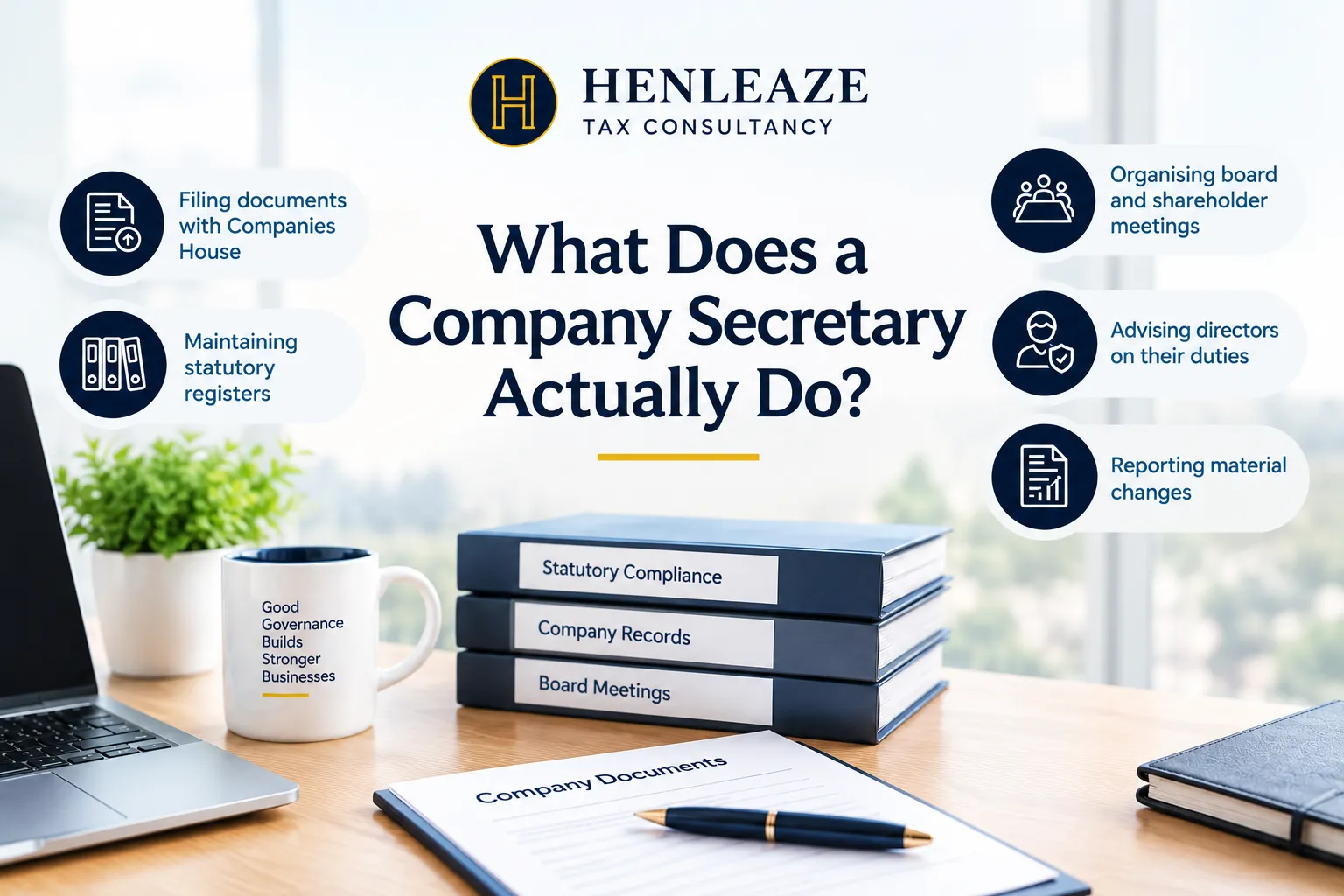
A company secretary's core job is keeping the company compliant and properly governed, covering a mix of statutory duties and day to day administrative support for the board.
The statutory duties typically include:
- Filing documents with Companies House, including the confirmation statement, on time
- Maintaining statutory registers, such as registers of directors, members and people with significant control
- Organising board and shareholder meetings, and keeping proper minutes of decisions made
- Advising directors on their duties, including disclosure obligations and best practice governance
- Reporting material changes to Companies House, such as changes to the registered office or share structure
Beyond these core duties, the day to day side of the role is fluid and tends to adapt to the size and stage of the company. In a small business, this often looks practical and process driven, keeping the company organised and properly documented, rather than the strategic governance work seen in larger organisations.
Is a Company Secretary the Same as a Director?
No. A director runs the business and makes commercial decisions, while a company secretary focuses on legal processes and governance. The two roles are distinct, even though one person can legally hold both at once in a private company.
| Role Feature | Director | Company Secretary |
|---|---|---|
| Main focus | Running the business, strategic and commercial decisions | Legal compliance, governance and statutory records |
| Legal status | Officer of the company, with fiduciary duties to act in its best interests | Also an officer of the company, with specific compliance duties |
| Required for private companies | Yes, at least one director is mandatory | No, optional unless the articles require it |
| Typical tasks | Decision making, signing contracts, setting strategy | Filing confirmation statements, maintaining registers, meeting minutes |
Where someone does wear both hats, it's worth being clear which role they're acting in for any given task, since each carries different legal duties. A director making a business decision and a company secretary filing a statutory document are doing fundamentally different jobs, even if it's the same person doing both.
Who Can Be a Company Secretary?
For a private limited company, there's no formal qualification requirement, any individual or appropriately structured organisation can take on the role. Public companies are different. The company secretary must have the knowledge and experience to carry out the role properly, demonstrated through a relevant professional qualification, legal qualification or sufficiently recent experience.
In practice, UK companies typically fill the role one of three ways: a director takes it on alongside their existing duties, a suitably experienced employee is appointed, or a third party professional, such as an accountant or law firm, handles it on retainer.
Company Director
A director absorbs the compliance responsibilities alongside business leadership duties.
Internal Employee
An experienced team member or operations manager is formally designated as secretary.
Third-Party Firm
An accounting or legal firm manages corporate filings and register maintenance on retainer.
What Happens If a Company Secretary Gets It Wrong?
A company secretary is an officer of the company, which means they can be held personally and, in serious cases, criminally liable for failures in their duties. This is worth taking seriously rather than treating the role as a formality.
Legal Liability Warning: Missed Companies House filings, inaccurate statutory registers, or failing to flag a compliance issue to the board can carry real consequences for the company and potentially for the person responsible.
A confirmation statement left unfiled for long enough can eventually lead to Companies House striking the company off the register entirely, at which point the company's assets can pass to the Crown and directors lose the ability to trade through it. Getting the basics right consistently matters more than it might first appear, and it's rarely a single dramatic failure that causes problems, more often it's small filings being missed repeatedly until HMRC or Companies House takes notice.
Should a Small Limited Company Appoint One Anyway?
Even though it's optional, many small limited companies choose to appoint a company secretary, or at least have someone clearly responsible for the role, because the underlying duties still have to be done by somebody. Where there's just one director, those duties automatically fall back on them.
For a single director limited company, the practical question isn't really "do I need a company secretary", it's "who is actually going to keep the confirmation statement filed, the registers accurate, and the records straight." Formally appointing someone, whether that's yourself, a colleague, or a professional provider, creates clarity about who's responsible, which matters more than the job title itself.
It's also worth understanding how this role sits alongside a director's own legal duties. We've covered the broader picture of a director's obligations in our guide to the responsibilities of a company director in the UK.
Appointing a Professional or Outsourced Company Secretary
A growing number of small businesses choose a third party provider rather than handling company secretarial duties internally, particularly once the admin becomes more than a quick annual task. This is a genuinely different arrangement to simply appointing a company secretary, and it's worth understanding the distinction properly, which we've covered in our guide to company secretary versus a company secretarial service.
Cost is usually the first question once outsourcing comes up, and it varies depending on how much is covered. We've broken down realistic UK pricing in our guide to company secretary cost.
If you'd rather see genuine local options than a generic national platform, our comparison of company secretarial firms in Bristol covers real providers across the city, including the kind of firm that suits a straightforward small company versus one with more complex governance needs.
We're based in Bristol and work with contractors, sole traders and small limited companies on a fixed fee basis. Company secretarial duties are something we handle alongside standard accountancy and tax work, rather than treating it as a separate add on.
Frequently Asked Questions
Final Words
A company secretary's job is making sure a company stays properly compliant and governed, filings on time, accurate records and clear support for the board, and while private companies aren't legally required to appoint one, those underlying duties still need to be done by somebody. For many small limited companies, deciding who's actually responsible matters more than the formality of the title itself.
If you're a contractor or run a small limited company and want your company secretarial duties handled properly alongside your wider tax position, take a look at our contractor accountant services to see how we can help.
Need Hassle-Free Company Secretarial Support?
We handle your confirmation statements, PSC updates, and Companies House filings on a fixed-fee basis alongside your tax and accounts.
Locations We Cover Across the UK
Providing proactive accounting, tax planning, and payroll support to businesses, landlords, and contractors across the UK.