
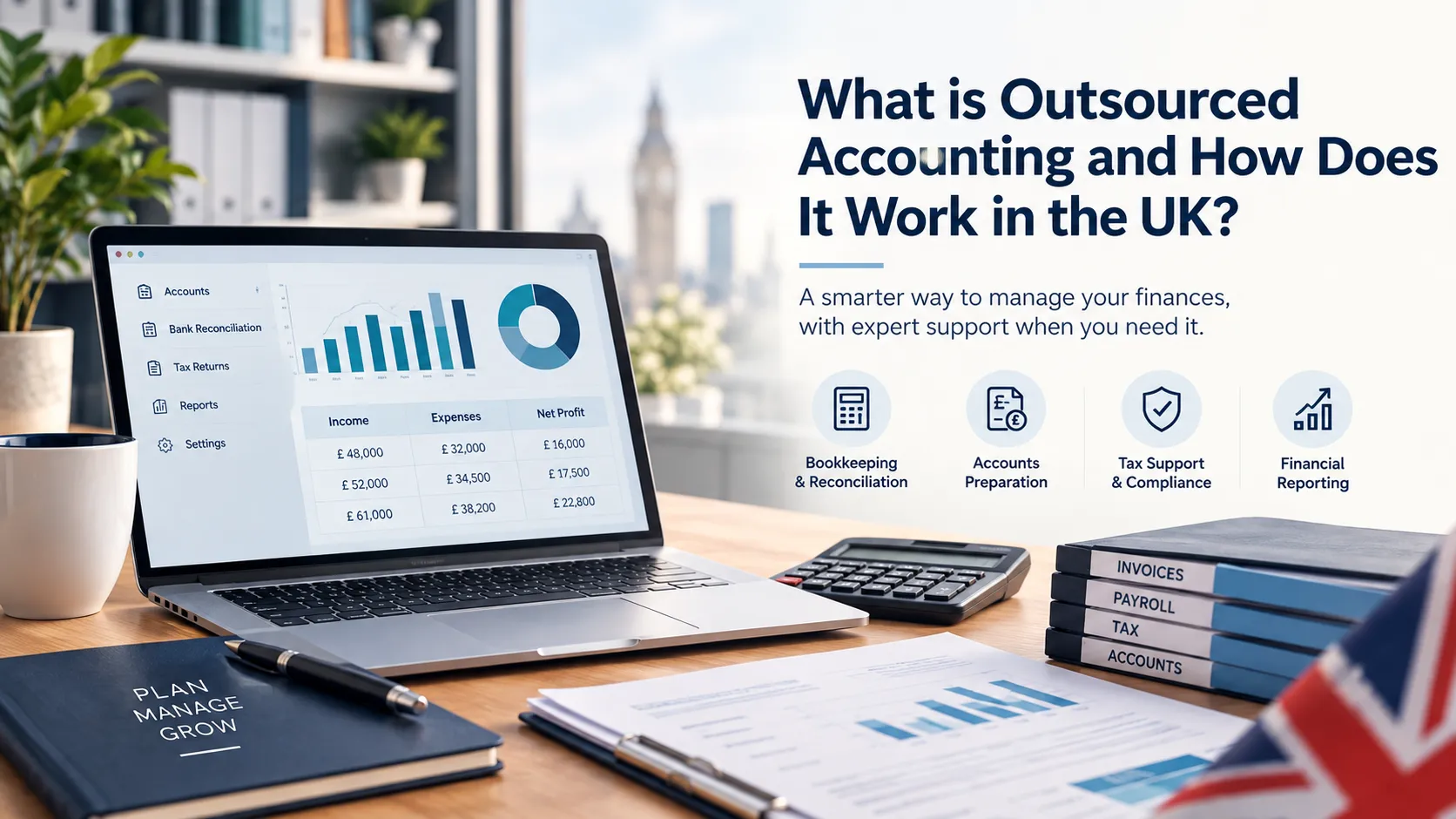
What is Outsourced Accounting and How Does It Work in the UK?
Everything you need to know about outsourced accounting in the UK, what it means, how it works, what it costs and who it's right for.
Outsourced accounting means paying an external accountant or accounting firm to handle some or all of your financial tasks, bookkeeping, payroll, VAT returns, management accounts, on an ongoing basis, rather than employing your own in-house staff to do it. You pay for this on a regular basis, usually monthly and the provider becomes responsible for keeping your books accurate and your filings compliant.
It's worth clearing up a common source of confusion early. A lot of content on this topic is actually written for accounting firms outsourcing their own bookkeeping work offshore, often to India, as a way of cutting labour costs. That's a completely different scenario to what most business owners searching for this term actually want to know, which is simply whether paying an external UK accountant to manage their books makes sense. This guide is about the second kind, a small business, contractor or growing company handing their accounting over to a dedicated external provider.
In This Article
What Functions Can Actually Be Outsourced?
Most of the ongoing financial work a business generates can be handed over to an external provider, either entirely or in part. The most commonly outsourced functions include:
Bookkeeping
Covering invoice processing, bank reconciliation and day to day record keeping.
Including PAYE, National Insurance and pension auto-enrolment compliance.
VAT Returns
Particularly important given Making Tax Digital requirements for VAT registered businesses.
Management Accounts
Giving you regular reporting on how the business is actually performing.
Annual Accounts & Tax Returns
The statutory compliance work most businesses are legally required to file.
Entire Finance Function
For businesses with no in house finance staff at all, sometimes including part time finance director support.
Some businesses outsource everything from day one. Others start by handing over bookkeeping and payroll, the most time consuming and repetitive tasks, while keeping more strategic financial decisions closer to the business.
How Does Outsourced Accounting Actually Work, Step by Step?
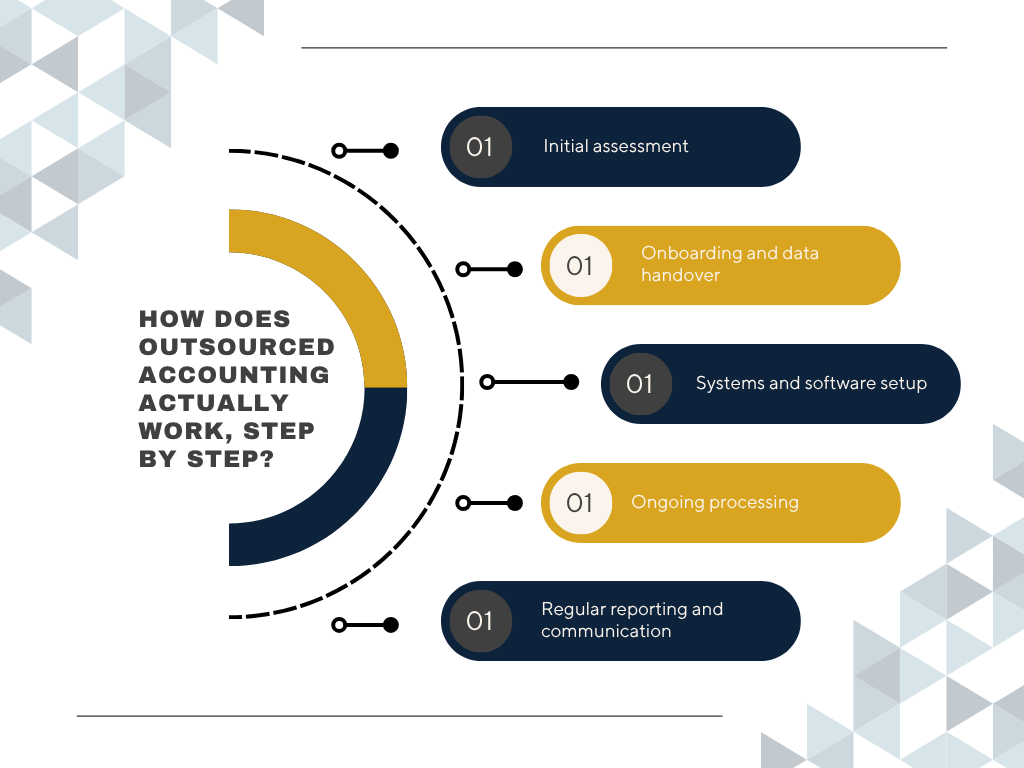
Outsourced accounting works through an ongoing, structured relationship, not a one off transaction. The process typically follows a consistent pattern regardless of which provider you use.
Initial Assessment
The provider reviews your current financial setup, existing software and what you actually need handled.
Onboarding and Data Handover
Historical records, software access and any existing processes get transferred across, either from you directly or your previous accountant.
Systems and Software Setup
Most outsourced accounting today runs on cloud based platforms like Xero or QuickBooks, giving both you and the provider real time access to the same numbers.
Ongoing Processing
Transactions get recorded, reconciled and reported on a set cadence, weekly, monthly or quarterly, depending on what you've agreed.
Regular Reporting and Communication
You receive management accounts, updates or direct answers to questions on an agreed schedule, rather than only hearing from your accountant once a year.
The relationship is meant to be collaborative rather than entirely hands off. You can stay as involved as you want, some business owners prefer regular check-ins, others are happy to let the provider run things and simply review the reports.
Who is Outsourced Accounting Right For?
Outsourced accounting suits a wide range of businesses, though it tends to make the most sense for a few specific situations:
- Small and growing businesses that don't yet have the transaction volume or budget to justify a full time in house hire.
- Startups that need proper financial infrastructure from day one without building an internal team.
- Contractors and sole traders who want their books handled properly without taking on employment overhead themselves.
- Businesses experiencing rapid growth, where transaction volume has outpaced whoever's currently doing the books.
- Companies going through a transition, such as losing an in house bookkeeper and needing continuity while they decide on a longer term solution.
Very large organisations with intensive, specialised accounting needs sometimes still prefer a dedicated in-house team, but for most small and medium sized UK businesses, outsourcing covers the need without the overhead.
Outsourced Accounting vs Hiring an Accountant vs an In House Team
These three options aren't quite the same thing and it's worth being clear on the distinction before deciding.
Usually means an annual relationship focused on compliance, filing your tax return once a year, with limited ongoing contact in between.
Broader and more regular, covering the day to day bookkeeping and reporting an in-house team would normally handle, not just annual compliance.
Means employing your own staff directly, with all the salary, National Insurance, pension and recruitment costs that involve.
We've covered this comparison properly, including a full cost breakdown for each option, in our guide to outsourced accounting versus in house accounting.
Is Outsourced Accounting Secure and Compliant in the UK?
Yes, provided you choose a properly regulated provider. Outsourced accounting involves handing over sensitive financial data, so it's worth understanding what genuine compliance actually looks like rather than taking a provider's marketing claims at face value.
Professional Body Regulation
Look for accountants regulated by the ICAEW or ACCA, which means they're bound by professional conduct standards and can be held accountable, unlike an unregulated bookkeeper.
UK Data Protection Compliance
Your provider should be handling your financial data in line with UK GDPR, with clear policies on how data is stored and who can access it.
Making Tax Digital (MTD) Compliance
Since VAT registered businesses are required to keep digital records and file through compatible software, your provider needs to be genuinely set up for this, not just claiming to be.
Data Security Standards
Certifications such as ISO 27001 or formal cloud security encryption standards, which evidence formal information security practices.
None of this means outsourced accounting is inherently risky. It generally means the opposite, a properly regulated provider often has stronger data security and compliance practices than a small business managing everything on its own systems. The key is checking these things upfront rather than assuming every provider meets the same standard.
What Does Outsourced Accounting Cost?
Costs vary significantly depending on what you're outsourcing and how complex your business is. Basic bookkeeping and VAT support for a small business typically costs somewhere in the range of £60 to £450 a month, while a fully outsourced finance function for a larger business can run into several thousand pounds monthly.
| Service Scope | Typical UK Pricing Range |
|---|---|
| Basic bookkeeping & VAT (sole trader / small SME) | £60 to £250 / month |
| Comprehensive bookkeeping, VAT & monthly payroll | £250 to £450 / month |
| Management accounts & forecasting | £300 to £800 / month |
| Fully outsourced finance department & virtual FD | £1,000 to £3,000+ / month |
We've broken this down properly, including a full range of typical UK pricing by service type, in our dedicated guide to how much outsourced accounting costs.
How to Get Started With Outsourced Accounting
Getting started is more straightforward than most business owners expect, though a little upfront thought makes the transition smoother:
If you're specifically in or around Bristol, our guide to outsourcing accounting firms in Bristol compares several genuine local providers if you'd rather see specific options than search from scratch.
We Handle Outsourced Accounting for Contractors and Small Companies
At Henleaze Tax Consultancy, we work specifically with contractors, sole traders, landlords and small limited companies across Bristol, offering fixed fee outsourced accounting rather than open ended hourly billing. For contractors in particular, outsourcing your accounting properly means getting your IR35 status and salary and dividend structure right from the start, not just having someone process transactions after the fact.
Frequently Asked Questions
Final Words
Outsourced accounting simply means handing your ongoing financial tasks to an external provider instead of managing them yourself or building an in-house team, and for most small and growing UK businesses, it works out more practical and often more cost effective than the alternatives. The key is choosing a properly regulated provider and being clear from the start about exactly what you want handled.
If you're a contractor or run a small limited company and want outsourced accounting handled properly, with IR35 and dividend planning built in rather than treated as an afterthought, take a look at our accountant services to see how we can help.
Ready to Switch to Fixed-Fee Outsourced Accounting?
Get a dedicated accountant, clean cloud bookkeeping, proactive IR35 and tax planning, all for an agreed monthly fixed fee.
Locations We Cover Across the UK
Providing proactive accounting, tax planning, and payroll support to businesses, landlords, and contractors across the UK.