
What is Tax Planning? A Complete Guide for UK Individuals & Businesses
Tax planning means organising your finances so you pay only the tax you legally owe, not a penny more. It is completely legal, HMRC does not discourage it and in the 2026-27 tax year it matters more than it has in a long time. Between rising compliance activity, changing rental income rules and shifting reliefs, the decisions you make this year could shape your tax position for several years to come.
Most people only think about tax once a year, usually around the self assessment deadline and by then a lot of the useful options have already closed. Real tax planning happens earlier than that, quietly, throughout the year, well before a deadline forces your hand.
This guide walks through what tax planning actually involves, who it is for and why 2026 -27 is turning out to be a genuinely pivotal year rather than just another routine tax cycle.
"Tax planning means organising your finances so you pay only the tax you legally owe, not a penny more. Real tax planning happens quietly throughout the year, well before a deadline forces your hand."
In This Article
What is Tax Planning, Exactly?
At its simplest, tax planning is the legal arrangement of your income, assets and financial decisions to make sure you are not paying more tax than necessary. It uses the reliefs and allowances Parliament has deliberately built into the system, things like pension contributions, the annual ISA allowance and capital gains exemptions.
People often confuse tax planning with tax avoidance, or worse, tax evasion. They are not the same thing.
| Term | What it means | Legal status |
|---|---|---|
| Tax planning | Using reliefs and allowances as intended, timing decisions sensibly | Fully legal and encouraged |
| Tax avoidance | Bending the rules or using aggressive schemes to reduce tax | Legal but often challenged by HMRC |
| Tax evasion | Deliberately hiding income or falsifying records | Illegal |
Good tax planning sits firmly in the first column. It is not about finding loopholes, it is about not leaving money on the table that Parliament never intended you to hand over in the first place.
Why 2026/27 is a Pivotal Year for Tax Planning
Every year, accountants say "this is an important year for tax planning." Most years, that is a bit of an exaggeration. This year, it genuinely is not, and here is why.
HMRC compliance activity is ramping up
HMRC is investing heavily in digital compliance and data matching technology, drawing on information from banks, property transactions, online marketplaces and even overseas tax authorities to identify undeclared income. As part of this push, HMRC plans to recruit thousands more compliance officers over the coming years, with over 2,000 already in post. In practical terms, the days of quietly under-reporting rental income or side earnings and hoping it goes unnoticed are pretty much over.
Rental income tax is rising from April 2027
This is one that a lot of Bristol landlords have not clocked yet. From 6 April 2027, new income tax rates will apply specifically to rental income, at 22 percent, 42 percent and 47 percent across the basic, higher and additional rate bands. That is a two percentage point rise on current rates. If you are a landlord thinking about selling a property or restructuring how you hold it, 2026 27 may be your last full tax year before the higher rates apply, which makes this the year to actually have that conversation rather than putting it off again.
Home working tax relief is disappearing
From April 2026, employees can no longer claim the flat rate home working tax relief, worth roughly £312 a year, directly through their tax code. It is a small number individually, but it affects a huge number of Bristol's hybrid and remote workers who have been claiming it automatically for years without a second thought.
If you work through your own limited company, it is also worth keeping an eye on the current IR35 rules, since your employment status directly affects how much of this tax planning applies to you versus an employer.
There is a rare bit of good news too. Alongside all the tightening, the government has also proposed simplifying inheritance tax reporting requirements in cases where no tax is actually due, which should mean less unnecessary paperwork for trustees and individuals dealing with smaller estates. Not everything this year is about paying more or filing more, some of it is genuinely about reducing admin.
Taken together, these changes mean 2026-27 is less about ticking the usual annual boxes and more about making a handful of real decisions before the window to act cheaply closes.
Who Needs Tax Planning?
Tax planning is not just for wealthy individuals or large companies. If any of the below applies to you, it is worth a proper conversation.
Business owners and company directors
Decisions on how you extract profit, whether through salary, dividends or pension contributions, directly affect how much tax you and your company pay.
Landlords and property investors
Particularly relevant this year given the rental income changes from April 2027 and the ongoing Section 24 mortgage interest restriction.
Families and individuals
Anyone thinking about retirement, passing on wealth, or simply making sure they are using their full allowances each year.
Growing businesses and contractors
As turnover and profit increase, so does the value of getting your structure right early, rather than fixing it retrospectively.
It is worth saying plainly, none of this requires you to be especially wealthy or to run a large operation. A sole trader earning a modest income, a landlord with a single buy to let property, or an employee with a workplace pension can all benefit from a proper review. The value of tax planning tends to scale with how many moving parts your finances have, not with how much money is involved.
Key Areas of Tax Planning
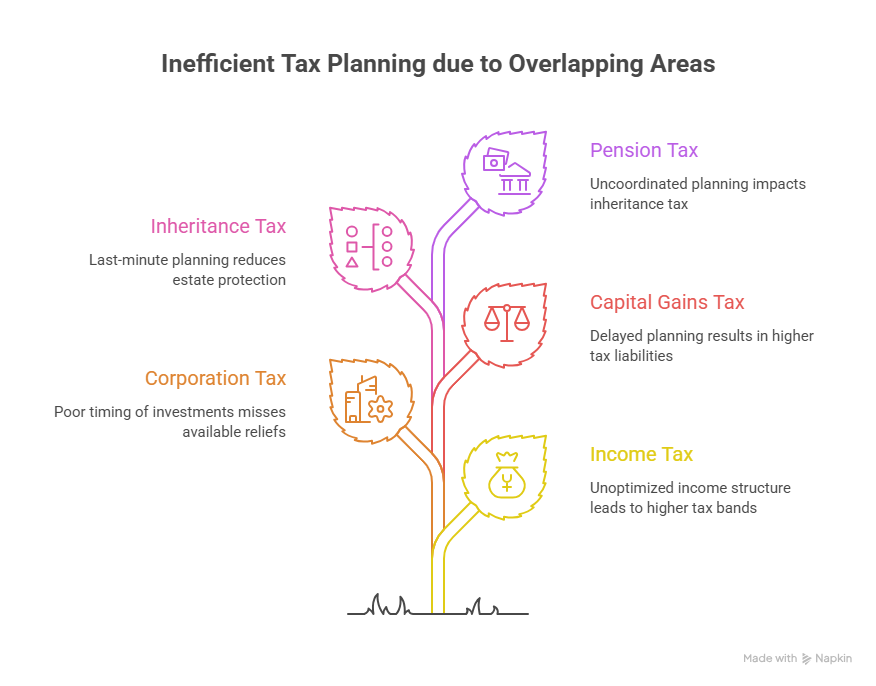
Tax planning is not one single thing, it covers several overlapping areas depending on your circumstances.
Income Tax Planning
Look at how your income is structured, including salary, dividends, pension contributions and allowances, to make sure you are not tipping unnecessarily into a higher tax band.
Corporation Tax Planning
Covers how a company manages its profits, reliefs and allowances, including timing of investment and expenditure to make the most of available reliefs before they change.
Capital Gains Tax Planning
It’s about understanding the tax implications of selling assets or property before you sell, not after, so you can make an informed decision and use available exemptions properly.
Inheritance Tax Planning
Focuses on protecting your estate for the next generation, using reliefs, gifting strategies and trust structures, all of which work far better when set up well in advance rather than at the last minute.
Pension and Retirement Tax Planning
Ties your pension contributions and withdrawals into your wider tax position, since the rules around how pensions interact with inheritance tax are shifting in the coming years.
These areas rarely sit in isolation. A decision about how you extract profit from your business, for example, has a knock on effect on your personal income tax position, your pension contributions and potentially your eventual inheritance tax exposure. Good tax planning looks at the whole picture rather than optimising one area in a way that quietly creates a problem somewhere else.
If you would like a closer look at how your business structure affects your tax position, our guide on contractor accounting services covers this in more detail, and our IR35 guide for UK contractors is useful if you work through your own limited company.
Not sure where you currently stand? Our free tax calculator gives you a quick, no obligation estimate of your position before you go any further.
Not sure where you currently stand?
Our free tax calculator gives you a quick, no obligation estimate of your position before you go any further.
When Should You Start Tax Planning?
The honest answer is before you make a decision, not after. Tax planning works best ahead of things like selling an asset, taking on a new directorship, retiring or passing on wealth. Once a transaction has happened, most of your options disappear.
This year specifically, if you are a landlord weighing up whether to sell before the April 2027 rental income changes or a business owner deciding how to extract profit given the current corporation tax bands, the planning window is now, not next spring when the changes are already in effect.
As a general habit, review your tax position at least once a year and again after any major life or business change.
Why Work With a Local Bristol Specialist
National platforms and app based tax services have their place, but they rarely understand the specifics of the Bristol property market, the mix of independent businesses across the city, or the practical realities facing local landlords with BS postcode portfolios. Our tax planning services are built specifically around that local context, rather than a one size fits all national template. For more specialised support, you can also compare tax advisory firms in Bristol to find an adviser suited to your circumstances.
Working with a Bristol based specialist means:
- Someone who understands the local property market, including the concentration of student lets and HMOs across parts of the city
- Direct access to the person actually doing your planning, rather than being routed through a call centre or a rotating point of contact
- Familiarity with the local business landscape, from independent retailers to growing contractor and consultancy businesses across the South West
If you would like to talk through your own situation, you can get in touch with our team for a tailored quote based on your circumstances.
Frequently Asked Questions
Final Words
Tax planning is not about clever tricks or aggressive schemes, it is simply about making sure you are not paying more than you legally have to and making decisions with enough notice to actually benefit from them. Given how much is changing this year, from rising compliance checks to the rental income rate rise coming in 2027, 2026 27 is a genuinely good year to have that conversation rather than waiting until the changes have already landed.
If you would like advice tailored to your own circumstances, speak to our tax planning team for a conversation built around your goals, not a generic checklist.
Locations We Cover Across the UK
Providing proactive accounting, tax planning, and payroll support to businesses, landlords, and contractors across the UK.