
Common Payroll Problems Small Businesses Face and How to Avoid Them in Bristol
The most common payroll problems small businesses face are wrong tax codes, late Real Time Information submissions, late PAYE payments, pension auto-enrolment mistakes, incorrect holiday and sick pay, and poor record keeping. Almost all of them come down to the same few causes: manual processes, missed deadlines, and out of date information about employees or tax rules.
The good news is that most payroll problems are preventable with a few simple checks, and most are fixable if you catch them early. This guide covers the problems that catch small businesses most often, what they cost when they go wrong, how to avoid them and what to do if you've already made a mistake.
In This Payroll Guide
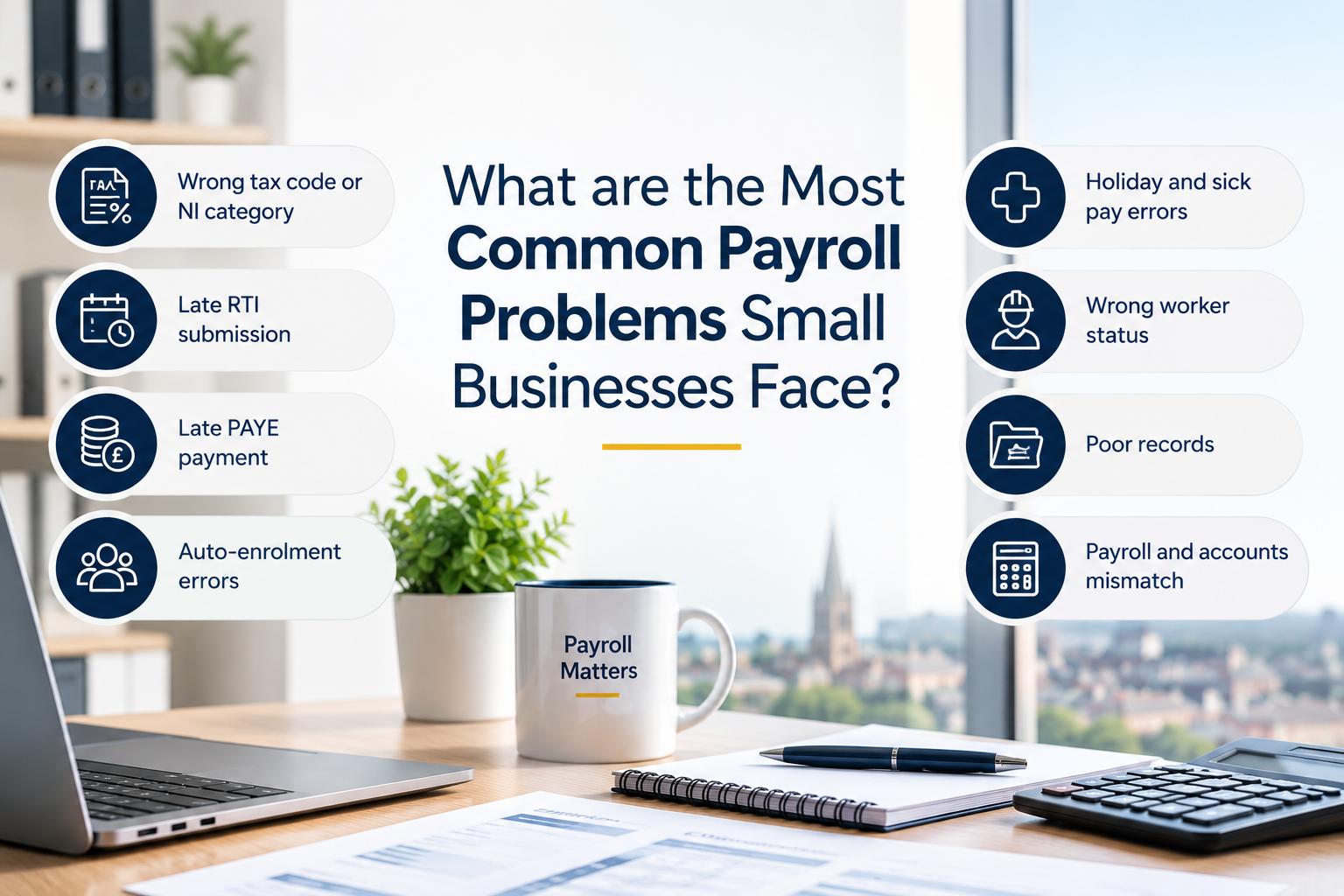
What are the Most Common Payroll Problems Small Businesses Face?
Most payroll problems fall into eight areas and each one has a predictable cause and a practical fix.
| Problem | Typical cause | Best prevention |
|---|---|---|
| Wrong tax code or NI category | Late starter details, ignoring HMRC notices | Collect starter details before the first pay run and check HMRC code notices |
| Late RTI submission | Filing after payday | Submit on or before payday, every pay run |
| Late PAYE payment | Cash flow, missed deadline | Set up a Direct Debit and diarise the 22nd |
| Auto-enrolment errors | Missed assessments, no re-enrolment | Assess every pay run and diarise the three year re-enrolment |
| Holiday and sick pay errors | Outdated rules, irregular hours | Use current rules and review after each change |
| Wrong worker status | Assuming invoicing means self-employed | Assess how the relationship actually works |
| Poor records | Loose files and spreadsheets | Store records securely for at least three years |
| Payroll and accounts mismatch | Two systems, manual reconciling | Reconcile every month |
Wrong Tax Codes and National Insurance Categories
An incorrect tax code or National Insurance category means employees pay too much or too little tax and the error usually only surfaces later. The standard code for most people with a single job is 1257L, but it changes when HMRC issues an updated code or when an employee has more than one income.
Common causes are simple: a starter checklist that arrives late, an HMRC code notice that gets missed or a National Insurance category letter that doesn't match the employee's circumstances. Category letters differ for employees under 21 and for apprentices under 25, for example, so a wrong letter changes how much National Insurance gets deducted.
To avoid this, collect starter details before the first pay run, check every HMRC code notice when it arrives and review categories whenever an employee's age or circumstances change.
Late or Missed RTI Submissions and PAYE Payments
Employers must send a Full Payment Submission to HMRC on or before every payday and late filing carries a monthly penalty that depends on the size of your PAYE scheme.
| Employees in your PAYE scheme | Penalty per month of late filing |
|---|---|
| 1 to 9 | £100 |
| 10 to 49 | £200 |
| 50 to 249 | £300 |
| 250 or more | £400 |
HMRC normally doesn't charge for the first late filing in a tax year and new employers who send their first submission within 30 days of first paying an employee aren't penalised. HMRC also informally tolerates submissions made within three days of payday, but this is a concession rather than a legal right, and repeat use can still lead to penalties. If a submission is more than three months late, an additional penalty of 5 percent of the tax and National Insurance reported late can apply.
Paying PAYE late is a separate problem with a separate penalty. The tax and National Insurance you've deducted is due by the 22nd of the month following the end of the tax month if you pay electronically, or the 19th if you pay by cheque. A tax month runs from the 6th to the 5th.
According to HMRC's internal manual on late payment penalties, the first late payment in a tax year doesn't count as a default for monthly payers. After that, penalties scale with the number of late payments.
| Late payments in the tax year (monthly payers) | Penalty on the amount paid late |
|---|---|
| 1 to 3 | 1 percent |
| 4 to 6 | 2 percent |
| 7 to 9 | 3 percent |
| 10 or more | 4 percent |
Further penalties of 5 percent apply where payments are still unpaid after six months and again after twelve months and interest builds daily on anything outstanding. A Direct Debit for your PAYE payment removes most of the risk.
Pension Auto-Enrolment Mistakes
Employers must assess every worker for auto-enrolment and enrol those who qualify, and even a business with one or two employees can have these duties. The most common mistakes are missing an assessment for a new starter, missing the point at which an existing employee's earnings cross the earnings trigger, paying contributions late and forgetting the re-enrolment exercise that comes round every three years.
These problems are usually quiet for a long time and expensive to unpick later. The Pensions Regulator can issue fixed and escalating penalties for non-compliance, so it's worth building assessments into every pay run rather than treating them as an occasional task. Payroll software with built in auto-enrolment checks helps, as does a diary reminder for your re-enrolment date.
Holiday Pay and Statutory Pay Miscalculations
Holiday and statutory pay errors usually come from rules that have changed or from pay that isn't the same every period. Two areas catch small businesses out most often.
Holiday pay for irregular hours
For leave years starting on or after 1 April 2024, employers can use a 12.07 percent accrual method for workers on irregular hours or part-year contracts. Regular overtime and commission also need to be considered when calculating holiday pay, so basing it on basic salary alone can leave employees underpaid.
Statutory sick pay
The rules changed on 6 April 2026. According to Acas, statutory sick pay is now payable from the first day of sickness, the lower earnings limit has been removed so workers no longer need to earn a minimum amount to qualify, and payment is the lower of 80 percent of average weekly earnings or the flat rate, which is £123.25 a week for 2026 27. Payroll set ups that still apply three waiting days or an earnings threshold will now produce wrong figures.
Getting Worker Status Wrong
Treating someone as self-employed when they should be an employee is one of the most expensive payroll mistakes, because it can mean unpaid PAYE, National Insurance and interest going back several years. Whether someone is an employee depends on how the working relationship actually operates, not on what the paperwork says and not on whether they send you an invoice.
Similar factors to those in our guide to how IR35 works, such as how much control you have over the work and whether the person can send a substitute, feed into employment status more generally. If you're unsure about someone's status, it's worth getting it checked before the first payment rather than after HMRC asks.
Poor Payroll Record Keeping
You need to keep payroll records for at least three years after the end of the tax year they relate to, and losing them is a problem the moment HMRC asks for evidence. Spreadsheets on one laptop and paper files in a drawer are the usual culprits.
Storing payroll history in your payroll software or a secure cloud folder, with automatic backups, solves most of this. Keep the records that support each pay run too: starter details, timesheets, pension assessments and any notes explaining a correction.
Payroll and Accounts That Don't Match
When payroll runs in one system and your accounts run in another, someone has to reconcile the two and that's where errors creep in. Missing journals and figures that don't agree mean your accountant ends up chasing corrections at year end.
The fix is a monthly reconciliation of your payroll report against your accounts, or a payroll setup that feeds your accounting software directly. If this sounds like a burden you'd rather not carry, our guide to what outsourced accounting is and how it works explains how an outside provider can take it on.
Payroll Problems Specific to Directors and Contractors
If you run your own limited company, payroll usually means paying yourself a salary and a few problems appear here that standard small business payroll guides rarely mention.
What to Do If You've Already Made a Payroll Mistake
If you've spotted a payroll error, the sensible approach is to correct it promptly, tell the employee and fix the records, rather than hoping it goes unnoticed. Correcting errors before HMRC finds them generally works in your favour.
Frequently Asked Questions
Final Words
Most payroll problems are avoidable with a few consistent habits: file on or before payday, pay HMRC by the deadline, assess for auto-enrolment every pay run, keep proper records and reconcile your payroll against your accounts each month. When something does go wrong, correcting it quickly is almost always cheaper than leaving it.
If you're a contractor or run a small limited company and want payroll handled correctly alongside your wider tax position, take a look at our contractor accountant services to see how we can help.
Need Accurate, Hassle-Free Payroll Support?
Avoid costly HMRC penalties and late filing fees. Speak to our Bristol chartered accounting team for full-service payroll, auto-enrolment management, and director pay optimisation.
Locations We Cover Across the UK
Providing proactive accounting, tax planning, and payroll support to businesses, landlords, and contractors across the UK.