
Company Secretary vs Company Secretarial Service: What's the Difference?
2026 Complete UK Guide to Appointed Officers, Secretarial Support, and Legal Compliance
A company secretary is a person appointed to a role within a company, while company secretarial services are the administrative and compliance tasks that help a company meet its legal obligations. These services may be provided by an external accountant, a specialist firm or another suitable service provider.
The terms are closely related, but they are not interchangeable. A company can appoint an individual as its secretary, outsource specific company administration tasks, or use a provider that handles the work and is also formally appointed as secretary. Understanding the difference helps you choose the right arrangement for your business, avoid paying for support you do not need and keep your company records in order.
In this guide
Company Secretary vs Company Secretarial Service: What's the Difference?
A company secretary is a person appointed to a role within a company, while company secretarial services are the administrative and compliance tasks that help a company meet its legal obligations. These services may be provided by an external accountant, a specialist firm or another suitable service provider.
The terms are closely related, but they are not interchangeable. A company can appoint an individual as its secretary, outsource specific company administration tasks, or use a provider that handles the work and is also formally appointed as secretary.
Understanding the difference helps you choose the right arrangement for your business, avoid paying for support you do not need and keep your company records in order.
What is a Company Secretary?
A company secretary is a person appointed to carry out certain administrative, statutory and governance responsibilities for a company. Their precise duties depend on the company's needs, its governing documents and the terms of their appointment.
The role can be particularly important in larger businesses where company records, board decisions and shareholder matters require regular attention.
Typical responsibilities may include:
Not every company secretary performs all these duties. Some focus on routine administration, while others provide broader governance support, depending on their experience and the company's requirements.
Does a private limited company need a company secretary?
Legal Stance: Companies Act 2006
No. A UK private limited company is not legally required to appoint a company secretary under section 270 of the Companies Act 2006. A public limited company must have one under section 271. (Companies Act 2006, sections 270 and 271).
If a private company does not appoint a secretary, certain tasks that would otherwise be handled by the secretary can be carried out by a director or someone authorised by the directors.
However, not having a company secretary does not remove the company's filing and record keeping obligations. Directors remain legally responsible for the company, including ensuring that its accounts and reports are properly prepared. (GOV.UK guidance on directors and company secretaries).
To learn more about how this applies to sole director and micro-businesses, read our comprehensive guide on whether small companies need a company secretary in the UK.
What are Company Secretarial Services?
Company secretarial services are professional services that help businesses manage their statutory records, Companies House filings and other company administration requirements. They can be provided by an accountant, a specialist company secretarial firm or a company formation agent.
The service can cover individual tasks or ongoing support, depending on the provider's package and your company's requirements.
Common services include:
The exact scope varies between providers. Some offer a basic filing service, while others provide more comprehensive company administration throughout the year.
For example, Henleaze Tax Consultancy's company secretarial services include support with confirmation statements, officer appointments, statutory records, share management and registered office services.
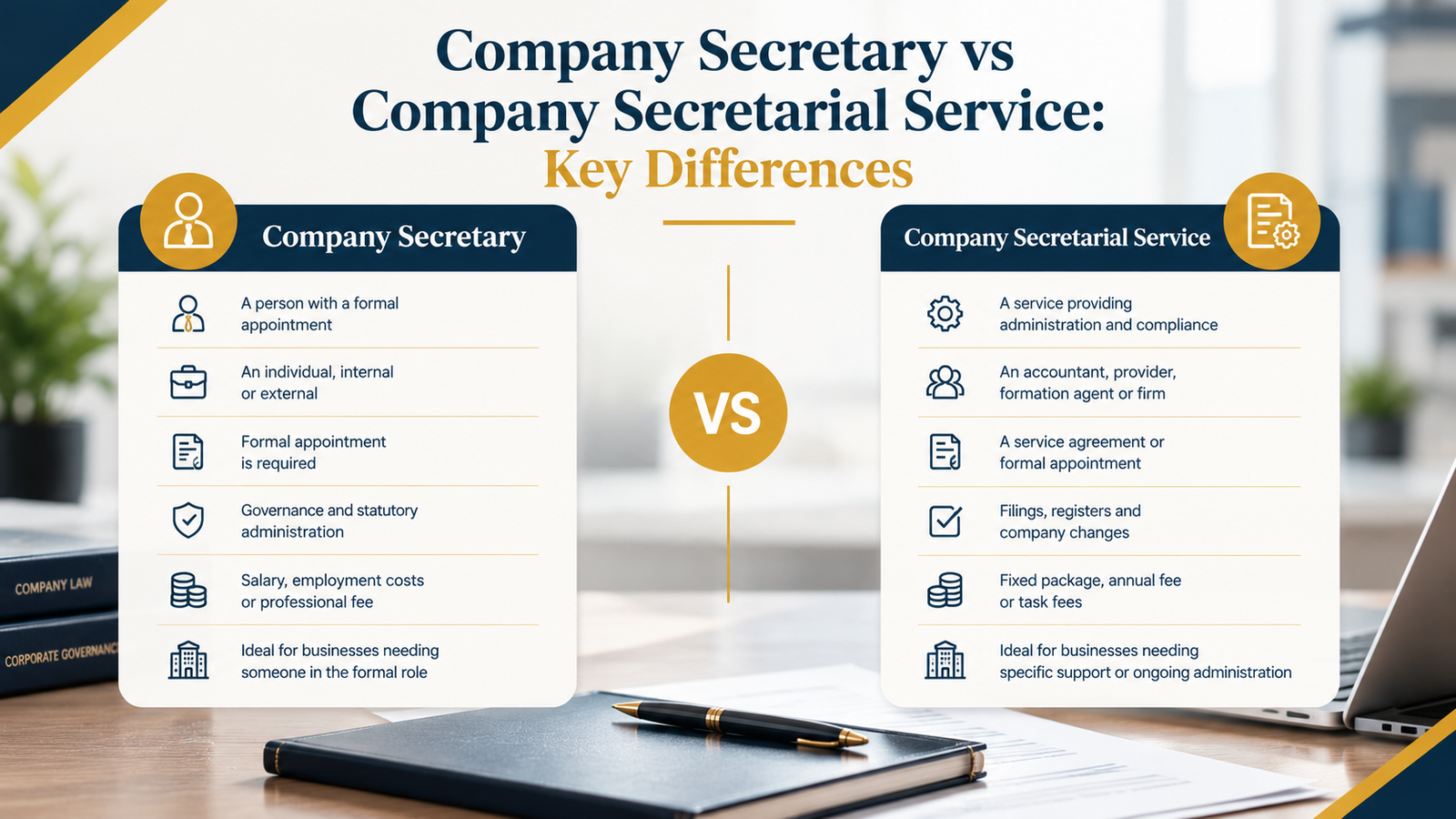
Company Secretary vs Company Secretarial Service: Key Differences
The main difference is that a company secretary is an appointed role, whereas company secretarial services describe the work being carried out. One relates to who holds the role, and the other relates to the support a company receives.
| Area | Company Secretary | Company Secretarial Service |
|---|---|---|
| What it means | A person formally appointed to the role | A service providing company administration and compliance support |
| Who provides it | An eligible individual, including someone working internally or externally | An accountant, specialist provider, company formation agent or other firm |
| Appointment | Formal appointment where the role is being filled | A service agreement may be sufficient for administrative support; a formal appointment is needed if the provider is to hold the office |
| Typical work | Duties assigned to the secretary, potentially including governance and statutory administration | Tasks agreed with the provider, such as filings, registers and company changes |
| Cost structure | May involve salary, employment costs or a professional fee | Often charged as a fixed package, annual fee or separate task fees |
| Best suited to | Businesses that need someone in the formal role, particularly public companies | Businesses that want help with specific tasks or ongoing company administration |
These categories can overlap. An external provider may offer company secretarial services and also be formally appointed as company secretary, if the arrangement is appropriate. Always check the engagement terms and the company's records to understand exactly what has been agreed.
What is the Difference Between Hiring a Company Secretary and Outsourcing the Work?
Hiring a company secretary means appointing someone to the role, while outsourcing means engaging an external provider to carry out agreed tasks. Outsourcing does not automatically mean the provider becomes the company's formally appointed secretary.
Hiring or Appointing a Company Secretary
A company that appoints a secretary has someone formally responsible for the duties assigned to that position. Depending on the arrangement, the person may be an employee, a director where permitted, or an external professional.
This option may suit a business that needs regular governance support, frequent board administration or a named person in the formal role. Public limited companies must have a company secretary and should ensure the appointment meets the applicable legal requirements.
Outsourcing Company Secretarial Tasks
With outsourced support, a company engages a third party to handle agreed administrative work. The provider might submit confirmation statements, update company records or prepare documents relating to changes in directors or share ownership.
This can be useful for small businesses that do not need a dedicated internal role. It also allows business owners to pay for the level of support they actually require.
Which Option is Better for a Small Business?
For many UK private limited companies, outsourced company secretarial support is a practical option because they do not have to appoint a company secretary. The right choice depends on how much administration the business has, how confident its directors are with compliance and whether it needs wider governance support.
Consider these situations:
There is no universal answer. Some businesses manage their own filings successfully, while others prefer to have a provider monitor deadlines and maintain their records.
What Should You Check Before Choosing a Provider?
Before appointing a company secretary or paying for a secretarial service, check the scope of work, the provider's experience and the responsibilities that remain with your directors.
Use the following checklist when comparing options:
Provider Evaluation Checklist
A clear agreement helps avoid gaps in responsibility and unexpected charges. It also makes it easier to change providers if your business requirements develop.
If price is a key consideration, read our guide to company secretary costs and duties in the UK for a breakdown of common pricing arrangements and what to check before choosing a package.
Looking for Reliable Company Secretarial Support?
From confirmation statements and registered office services to statutory register management, Henleaze Tax Consultancy keeps your UK company compliant and penalty-free.
Frequently Asked Questions
Final Words
The difference between a company secretary and a company secretarial service comes down to the formal role and the work involved. A company secretary is appointed to a position, while a secretarial service provides agreed support with filings, records and company administration. Depending on the arrangement, an external provider can do the work without holding the role or can also be formally appointed.
For a small private company, outsourced support may be enough. Businesses with more demanding governance requirements may need a formal appointment or a broader level of professional support.
Have questions about keeping your company records compliant? Contact the Henleaze Tax Consultancy team today for friendly, expert guidance tailored to your business structure.
Locations We Cover Across the UK
Providing proactive accounting, tax planning, and payroll support to businesses, landlords, and contractors across the UK.