
Annual Salary Calculation UK: A Simple Guide for Every Pay Type
Work out your annual salary from an hourly rate, monthly pay, part time hours or contract income, with formulas and real examples.
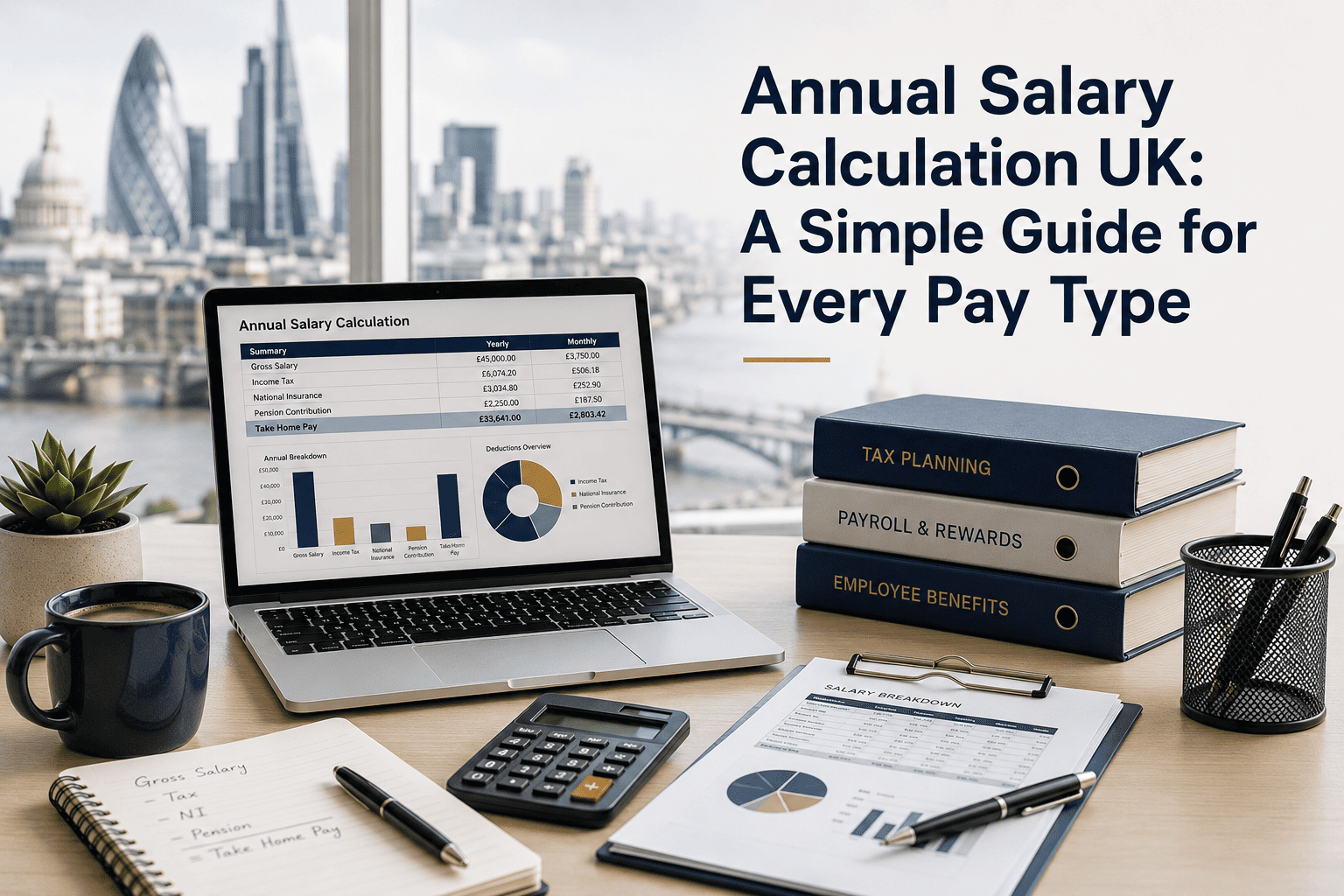
Your annual salary is your total pay for a full year before any deductions and how you calculate it depends on how you're actually paid. If you're on an hourly rate, you multiply your rate by your weekly hours and by the weeks you work in a year. If you're paid monthly, you simply multiply your monthly figure by twelve. Part time work, overtime and self employed income each need a slightly different approach, which is what this guide walks through.
"Your annual salary is the gross figure you'd earn over twelve months, before Income Tax, National Insurance, or pension contributions are taken off."
In This Article
What Does Annual Salary Mean?
Annual salary is the gross figure you'd earn over twelve months, before Income Tax, National Insurance, or pension contributions are taken off. It's the number you'll usually see quoted in a job advert or written into a contract and it's also the figure used as the starting point for most UK salary calculators.
One thing worth knowing early: for a standard salaried employee, annual salary already includes your paid holiday. UK employees are entitled to a minimum of 5.6 weeks of paid annual leave, so you're not expected to work all 52 weeks of the year to earn your full salary, the time off is already built in and paid.
Hourly Rate to Annual Salary: How to Work It Out
If you know your hourly rate and want to work out what that comes to over a year, the formula is straightforward.
Formula
Annual salary = hourly rate × hours worked per week × weeks worked per year
For a typical full time employee on paid holiday, use 52 weeks, since holiday time is paid and already counted in. For example, someone earning £15 an hour, working 37.5 hours a week, for 52 paid weeks, would work out as follows:
£15 × 37.5 hours = £562.50 a week
£562.50 × 52 weeks = £29,250 a year
If you're on a casual or zero hours arrangement where unpaid time off is genuinely unpaid, you'd use the actual number of weeks you expect to work instead of 52, since you're only being paid for hours actually worked.
Annual Salary to Hourly Rate: How to Work It Out
The same formula works in reverse if you're starting from an annual figure and want to know your effective hourly rate.
Formula
Hourly rate = annual salary ÷ weeks worked per year ÷ hours worked per week
Taking the same numbers from above, £29,250 divided by 52 weeks gives £562.50 a week and £562.50 divided by 37.5 hours gives £15 an hour. This is a common question on its own, particularly when comparing a day rate or a new job offer against your current hourly earnings.
How to Calculate Your Annual Salary From a Monthly Salary
This is the simplest conversion of the three, but it's also where a common mistake creeps in.
Formula
Annual salary = monthly salary × 12
If your monthly pay is £2,500, your annual salary is £30,000. Straightforward. The mistake people make is multiplying a weekly figure by four to estimate a monthly amount, or a monthly figure by four to estimate a weekly one. Since months vary in length and the year doesn't divide evenly into four week blocks, this shortcut produces a slightly wrong number. We've covered the correct approach in detail in our guide to calculating your monthly salary.
Common Mistake: The ×4 Shortcut
Never multiply a weekly figure by four to get a monthly amount, or vice versa. Most months contain more than four weeks, so this shortcut always underestimates the correct figure. Always multiply monthly by 12 for the annual total.
How to Calculate Your Annual Salary If You Work Part Time
Part time annual salary is usually calculated as a proportion of the equivalent full time salary, based on the hours you actually work.
Formula
Part time annual salary = full time equivalent salary × (your hours ÷ full time hours)
For example, if a full time role is advertised at £30,000 a year based on a 37.5 hour week, and you're working 22.5 hours a week, your pro rata salary would be:
£30,000 × (22.5 ÷ 37.5) = £18,000 a year
This calculation matters beyond just knowing your own pay. It's also the basis employers use for pro rata holiday entitlement, pension contributions and statutory pay calculations, so it's worth getting right if you're comparing offers or checking your own figures.
How to Calculate Your Annual Salary With Overtime, Bonuses or Irregular Hours

Base salary calculations assume consistent hours, but a lot of real pay includes variable elements that don't fit neatly into a single formula.
Regular Overtime
Estimate your average extra hours over a few months, then add that value to your base annual figure using your normal or overtime hourly rate.
Bonuses
Usually treated separately from your base salary rather than folded into it, since they're not guaranteed year to year.
Irregular Hours
Common in shift work or zero hours contracts. Best estimated by averaging your actual earnings over three to six months and multiplying that average by twelve, rather than assuming a single typical week represents the whole year.
If your income varies significantly month to month, an average based estimate will give you a more realistic annual figure than a formula built around a single fixed week.
Common Mistakes When Calculating Annual Salary in the UK
- Assuming 52 working weeks when unpaid leave applies. If you take genuinely unpaid time off, your real annual earnings will be lower than a straight 52 week calculation suggests.
- Multiplying a weekly figure by four to get a monthly one. This consistently underestimates the correct monthly amount because most months are slightly longer than four weeks.
- Ignoring pension contributions or salary sacrifice arrangements when comparing job offers. These reduce your taxable salary even though the advertised annual figure stays the same.
- Treating a single good or bad week as typical when income varies. Average over a longer period for a more realistic figure rather than using one representative week.
How Self-Employed Contractors Estimate Their Annual Income
Annual income for self employed contractors works differently to a standard salary calculation, since there's no fixed weekly or monthly figure to multiply. A common approach is to estimate your realistic billable days for the year first, then multiply that by your day rate.
Start from 52 weeks
Subtract weekends, typically bringing you to around 260 working days.
Subtract holiday and time between contracts
Very few contractors bill every single working day of the year.
Realistically billable: 220 to 230 days
This is a typical contracting pattern. Multiply your day rate by this figure for a rough annual income estimate.
This gives you contract revenue rather than take home pay. Your actual take home figure depends heavily on your IR35 status and how you structure salary and dividends, which we've covered in detail in our guide to inside versus outside IR35.
If you want a proper picture of your annual income as a contractor, our contractor accountant services can build a realistic figure around your actual contract pattern rather than a rough estimate.
A Worked Example
Bringing a few of these together, imagine someone working 30 hours a week at £18 an hour, for 46 paid weeks a year after accounting for a period of unpaid leave.
| Step | Calculation | Result |
|---|---|---|
| Weekly pay | £18 × 30 hours | £540 |
| Annual salary | £540 × 46 weeks | £24,840 |
That £24,840 is the gross annual figure, before tax, National Insurance, or pension contributions are applied. Use our tax calculator to see what you'd actually take home from this figure.
For the most up to date Income Tax rates and thresholds used in these calculations, check the current rates on gov.uk directly.
Frequently Asked Questions
Locations We Cover Across the UK
Providing proactive accounting, tax planning, and payroll support to businesses, landlords, and contractors across the UK.