
How to Calculate Your Monthly Salary From Your Annual Pay in the UK
Most people get this calculation slightly wrong. Here's the correct way to work out monthly salary from annual pay in the UK, with examples.

Your monthly salary is your annual salary divided by 12. That's it, that's the calculation for anyone paid a fixed yearly amount and receiving equal payments each month, which covers most salaried employees in the UK. The confusion usually starts when people try a different shortcut, like multiplying a weekly figure by four and end up with a number that doesn't match their actual pay. This guide covers the correct method, why that shortcut goes wrong and how the calculation changes if you're paid hourly, work part time or run your own limited company.
"Your monthly salary is your annual salary divided by 12. For most salaried UK employees, this gives your exact gross monthly figure before tax and NI deductions."
Try Our Calculator
Calculate your exact take-home pay, tax and National Insurance deductions instantly.
In This Article
What is Monthly Salary and How is It Calculated in the UK?
Monthly salary is the gross amount you receive each month before Income Tax, National Insurance or pension contributions are deducted. For most UK employees paid an annual salary in twelve equal installments, the formula is simple.
If your annual salary is £36,000, your gross monthly salary is £3,000. This figure stays the same every month, regardless of whether that particular month has 28, 30 or 31 days in it, since you're being paid a twelfth of your yearly total, not a daily rate multiplied by days worked.
Why You Shouldn't Multiply Your Weekly Pay by Four
This is genuinely the most common mistake people make and it's worth understanding why it happens.
A year has 52 weeks, not 48. If you divide 52 by 12, you get roughly 4.33 weeks per month, not 4. Multiplying your weekly pay by four consistently underestimates your true monthly figure, because you're leaving out that extra third of a week hiding in almost every month.
Here's where it gets more confusing. Some salary calculators use weekly pay multiplied by 4.33 as their method, rather than annual salary divided by 12. For a salaried employee with a fixed annual figure, these two methods should give you the same answer, since 4.33 weeks times 12 comes to roughly 52 weeks, matching the year. The safest and simplest approach, if you already know your annual salary, is to divide by 12 directly rather than working back through weekly figures and risking a rounding error along the way.
If you're paid weekly rather than salaried and want to estimate a monthly equivalent, use the 4.33 multiplier rather than 4 or better still, work out your annual figure first using 52 weeks, then divide that by 12.
How to Calculate Your Monthly Salary Step by Step
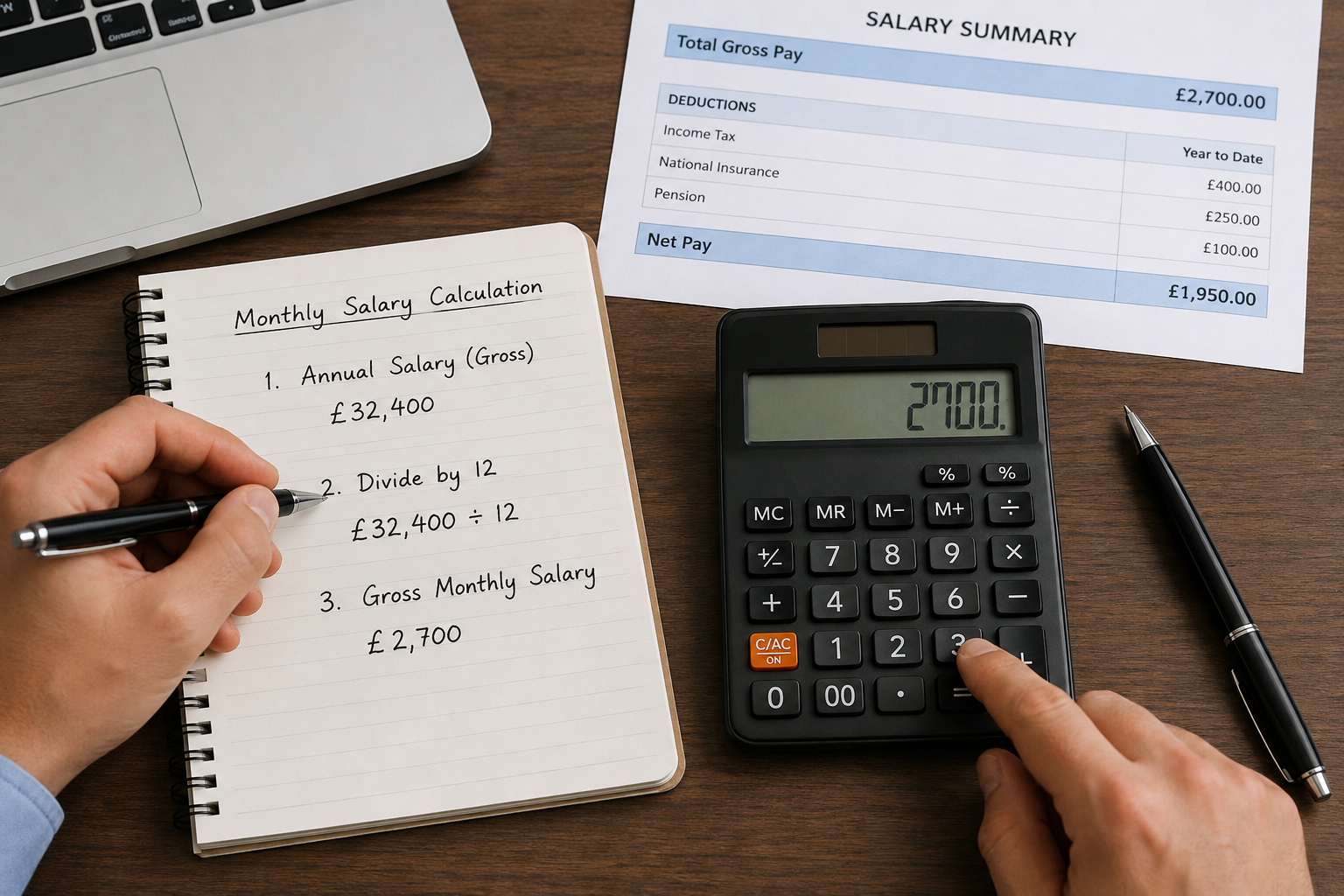
Bringing this together, here's the full sequence for someone converting an annual salary into a monthly figure:
Take your gross annual salary
The total agreed yearly pay figure before any tax or deductions.
Divide it by 12
This distributes your annual earnings evenly across all 12 calendar months.
Get your gross monthly salary
This is your gross monthly earnings, before Income Tax, National Insurance and pension contributions are deducted.
For example, someone on an annual salary of £42,000 would calculate their monthly salary as £42,000 divided by 12, which comes to £3,500 a month, gross. Their actual take home figure would then be lower once tax, National Insurance and any pension contributions are applied.
What If You Start or Leave a UK Job Partway Through a Month?
This is where a lot of people get an unexpected pay figure and it's a genuinely common situation, whether you're starting a new role, leaving one or taking a period of unpaid leave.
UK employers typically use one of two methods to work out a partial month's pay:
Method 1: The Working Day Method
Looks at how many working days are in the month, then pays you for the proportion you actually worked:
- Work out your full monthly salary.
- Divide it by the number of working days in that specific month.
- Multiply that daily rate by the number of days you actually worked.
Method 2: The Calendar Day Method
Works similarly but divides by the total number of days in the month, including weekends, rather than just working days. Different employers use different methods, so if your first or last payslip looks smaller than expected, it's worth checking which approach your employer applies, since the two methods produce slightly different results.
Working Out Your Monthly Pay From an Hourly Rate or Day Rate
If you're not on a fixed annual salary, the calculation needs an extra step first.
For an hourly rate: multiply your hourly pay by your weekly hours, then by 52 weeks to get an annual figure, then divide by 12 to reach a monthly estimate. We've covered the hourly to annual conversion in detail, including different working patterns, in our guide to calculating your annual salary from an hourly rate.
For a day rate: common among contractors and freelancers, the calculation is less predictable, since monthly income depends on how many days you actually worked or invoiced that month, rather than a fixed number. Multiplying your day rate by the working days in a typical month gives a rough estimate, but actual monthly income will vary depending on your contract pattern.
Whatever your pay structure, it's worth checking your effective hourly rate periodically against the National Minimum and National Living Wage rates, particularly if you're on a day rate or piece work basis, since these are reviewed and updated each April.
Monthly Income If You're Self Employed or a Contractor
If you run your own limited company, there's no single monthly salary figure to divide, since your income typically comes from a mix of a modest salary and dividends and both can vary depending on how your company performs and how you choose to draw funds.
A practical approach many contractors use is to work out their expected annual income first, based on realistic billable days and their day rate, then divide that by 12 to give themselves a stable monthly figure to budget against, even if the actual timing of invoices and dividend payments is less predictable in reality. This smooths out the natural unevenness of contract income into something that resembles a regular monthly salary for personal budgeting purposes.
Your actual take home figure will also depend heavily on your IR35 status, which affects whether you're taxed similarly to an employee or as a genuine business. We've covered this in detail in our guide to inside versus outside IR35. For an accurate monthly figure based on your specific contract and company structure, our contractor accountant services can help you plan around real numbers rather than a rough estimate, something we regularly help contractors across Bristol and further afield work through properly.
Common Mistakes When Calculating Monthly Salary in the UK
Multiplying weekly pay by four instead of 4.33, or dividing annual salary by 4 instead of 12.
Both consistently produce an underestimated figure due to ignoring the extra days in each month.
Assuming every month pays the same if you're on a day rate or hourly contract.
Unlike a fixed salary, variable income genuinely differs month to month depending on actual days and hours worked.
Confusing gross and net monthly salary.
The annual divided by 12 calculation gives you a gross figure. Your actual take home pay will be lower once tax, National Insurance and any pension contributions are deducted.
Not checking which part month calculation method your employer uses.
The working day and calendar day methods can produce noticeably different results for a partial month, so don't assume one without checking your contract.
A Worked Example
Bringing several of these elements together, here's a full example for someone on a fixed annual salary who joined partway through a month:
| Step | Calculation | Result |
|---|---|---|
| Annual salary | Given | £39,000 |
| Full gross monthly salary | £39,000 ÷ 12 | £3,250 |
| Working days in the month | Given | 22 |
| Daily rate | £3,250 ÷ 22 | £147.73 |
| Days actually worked | Given | 15 |
| Partial month pay | £147.73 × 15 | £2,215.95 |
That final figure, £2,215.95, is the gross amount they'd expect to see on their first payslip, before tax and National Insurance are applied.
Frequently Asked Questions
Locations We Cover Across the UK
Providing proactive accounting, tax planning, and payroll support to businesses, landlords, and contractors across the UK.