
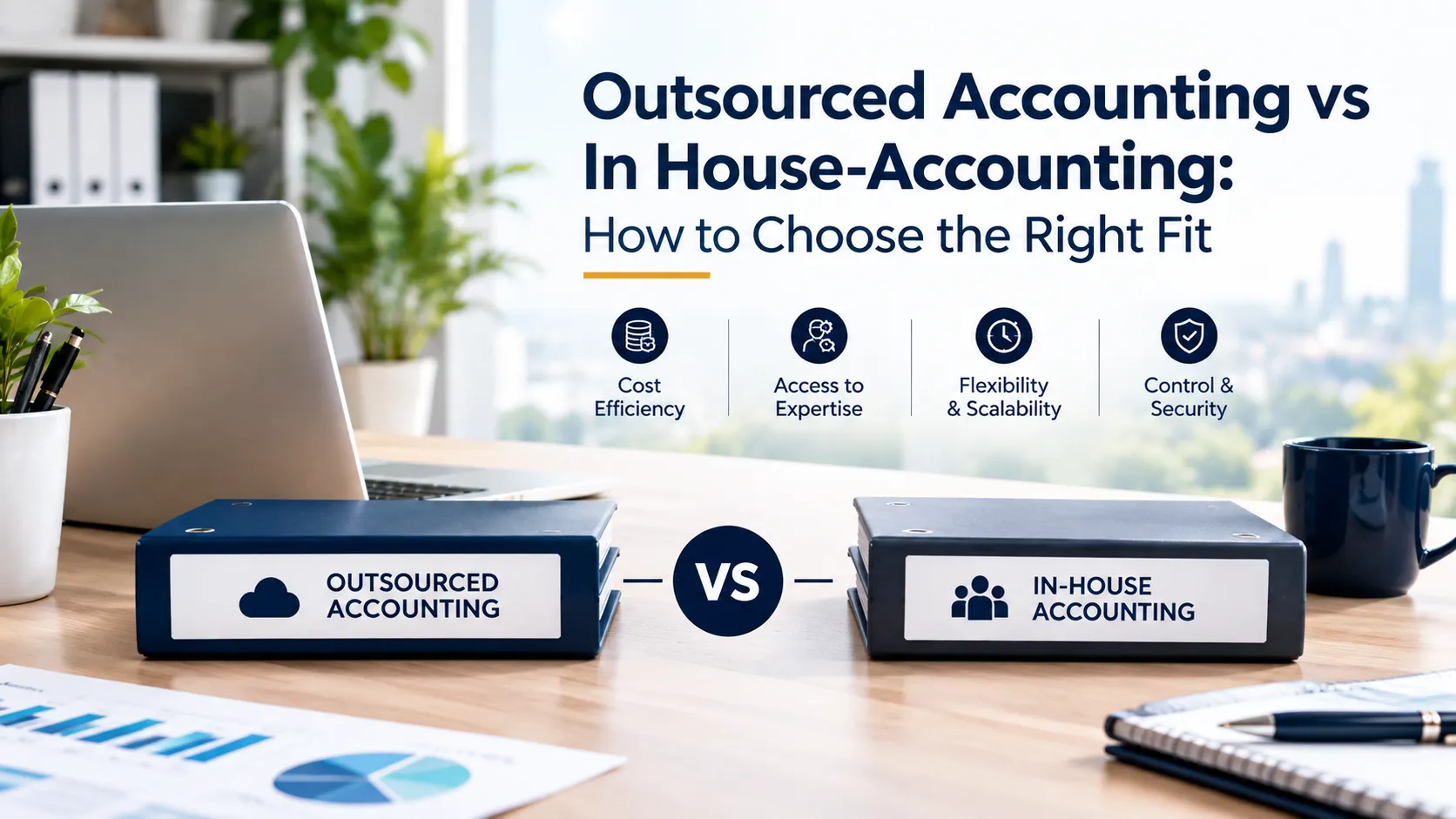
Outsourced Accounting vs In House-Accounting: How to Choose the Right Fit
Cost, expertise, scalability and compliance risk compared side by side, so you can work out which accounting setup actually fits you.
For most small and growing UK businesses, outsourced accounting works out cheaper, more flexible and gives access to broader expertise than hiring in-house, while in-house accounting suits larger businesses with high transaction volumes who value having a dedicated team physically embedded in the business. There isn't a single universally correct answer, the right choice depends on your size, complexity and how much control you want over day to day financial management.
This guide compares both options properly, cost, expertise, scalability, compliance and control, so you can work out which genuinely fits your business rather than assuming one is automatically better. If you haven't already, our guide to what outsourced accounting is and how it works is worth reading first if you're still working out the basics.
In This Comparison Guide
What's the Real Difference Between Outsourced and In-House Accounting?
In-house accounting means directly employing your own staff to manage bookkeeping, payroll and financial reporting, while outsourced accounting means paying an external provider to handle the same work on an ongoing basis. The core functions covered are often identical, the difference is entirely in how that work gets staffed and paid for.
In-house accounting gives you a team physically present in the business, familiar with its day to day workings. Outsourced accounting trades some of that direct familiarity for lower overheads, broader expertise, and the ability to scale support up or down as needed.

Cost Comparison: Outsourced vs In-House Accounting
Cost is usually the deciding factor for most small businesses and it's worth comparing properly rather than assuming outsourcing is automatically cheaper.
| Cost factor | In-House Accountant | Outsourced Accounting |
|---|---|---|
| Base salary | £35,000 to £65,000+ per year, depending on seniority | Single monthly fee, typically £60 to £1,000+ depending on scope |
| Employer National Insurance | Additional cost on top of salary (13.8% to 15%) | Included in the fee |
| Pension contributions | Additional cost on top of salary (minimum 3% employer contribution) | Included in the fee |
| Recruitment costs | Time and fees to hire and replace staff (typically 15% to 25% of salary) | None |
| Software and licensing | Paid separately by the business (Xero, Sage, payroll portals) | Usually included in monthly package |
| Training & CPD | Ongoing cost as tax rules and accounting software change | Provider's responsibility |
| Holiday and sick cover | Business must arrange and pay for cover when staff are off | Covered continuously by the provider's team |
A full time in-house hire also carries hidden costs that rarely appear in a straightforward salary comparison, recruitment delays while a role sits vacant, staff turnover requiring the process to start again and underutilisation if the workload doesn't consistently justify a full time position. We've broken down realistic UK pricing for outsourced accounting specifically in our guide to what outsourced accounting costs in the UK.
Expertise: Who Actually Knows More About Your Finances?
In-house accountants build deep familiarity with your specific business, but their knowledge is limited to what one person has encountered. Outsourced providers typically bring broader, more current expertise across a wider range of situations, since they're working with multiple clients rather than just yours.
This matters most outside routine bookkeeping. VAT complexities, R&D tax relief eligibility, or IR35 status for contractors are all areas where a single in-house hire may simply never have encountered the specific situation before, while a specialist outsourced provider handles these regularly.
Depth vs Breadth of Knowledge
An in-house employee understands company history and day-to-day culture exceptionally well. However, when complex tax legislation shifts or an HMRC enquiry opens, an outsourced firm provides immediate access to chartered tax advisers, VAT specialists, and payroll experts who handle these challenges on a daily basis.
Scalability: Which Option Grows With Your Business?
Outsourced accounting scales more easily than an in-house team, since support can be adjusted without a fresh recruitment process each time. In-house accounting requires hiring additional staff as workload grows, which takes time and adds ongoing cost regardless of whether the extra capacity is needed every month.
For a business going through a growth phase, taking on new clients, adding staff, or expanding into new areas, outsourcing tends to accommodate that change faster than recruiting can.
Compliance and Risk: Which Option Reduces Your Exposure?
Outsourced providers generally reduce compliance risk, since tracking HMRC deadlines and regulatory changes is their core responsibility rather than one task among many for an in-house employee or business owner. Missed deadlines carry real financial consequences, late annual accounts filed more than six months overdue can mean a £1,500 penalty and persistent non compliance with confirmation statement filing can eventually lead to Companies House striking a company off the register.
An in-house accountant can absolutely manage compliance well, but the risk concentrates in one person. If they're unwell, leave, or simply miss something during a busy period, there's no built-in backup the way there often is with an outsourced team.
Single Point of Failure vs Continuous Coverage
With a lone internal accountant, unexpected sickness during month-end or statutory filing windows can quickly trigger costly penalties. Outsourced practices maintain robust internal cover so your payroll, VAT, and annual accounts never pause.
Control and Availability: Where In-House Still Wins
In-house accounting genuinely does win on one thing consistently, direct, immediate access to someone who knows your business inside and out, without needing to explain context every time. For businesses with complex, fast moving daily transactions, or those who simply prefer having someone physically present, this remains a real advantage outsourcing doesn't fully replicate.
Outsourced providers generally offer structured communication, scheduled check-ins, defined response times, rather than someone sitting down the hall available at a moment's notice. For most small businesses this trade off is worth it, but it's a genuine consideration for larger, more transaction heavy operations.
Quick Comparison
Here is how in-house accounting and outsourced accounting stack up side by side across the six key decision metrics:
| Factor | In-House Accounting | Outsourced Accounting |
|---|---|---|
| Cost | Higher, fixed overhead regardless of workload | Lower, scales with actual need |
| Expertise | Limited to one person's knowledge and experience | Broader, specialist access across multiple disciplines |
| Scalability | Slower, requires a new recruitment cycle each time | Faster, adjust service scope whenever required |
| Compliance risk | Concentrated in one person | Spread across a dedicated, supervised team |
| Availability | Immediate, physically present on site | Structured, scheduled communication & ticketed support |
| Best suited for | Larger businesses, high daily transaction volumes | Most small and growing businesses, sole traders & contractors |
Is a Hybrid Approach Ever Right?
Yes, for some larger or more complex businesses, a hybrid model combining a small in-house team with outsourced specialist support can work well. This typically means keeping day to day bookkeeping in-house, close to the business, while outsourcing specialist areas like tax planning, payroll, or annual compliance to an external provider.
For most small businesses and contractors, though, a hybrid setup adds complexity without the transaction volume to justify it, and fully outsourcing tends to be the simpler, more cost effective route.
What This Means for Contractors and Small Limited Companies
For a contractor running their own limited company, the in-house versus outsourced question barely applies in the traditional sense, there's rarely a genuine option to employ a full time in-house accountant for a single director business. The real decision is closer to choosing between a general outsourced provider and one who understands contractor specific situations properly.
Getting your IR35 status assessed correctly, and structuring salary and dividends appropriately, matters more for take home pay than almost any other decision a contractor makes. We've covered the financial difference this makes in our guide to inside versus outside IR35.
We work with contractors, sole traders and small limited companies across Bristol specifically, on a fixed fee basis, if you'd like to see what this looks like for your own situation, our contractor accountant services page covers what's included.
Frequently Asked Questions
Final Words
There's no universally correct answer between outsourced and in-house accounting, the right choice depends on your size, complexity and how much direct control you want. For most small businesses, contractors and growing companies, outsourcing tends to win on cost, expertise and scalability, while in-house accounting still has a genuine place for larger, transaction heavy operations that value having a dedicated team on site.
If you're a contractor or run a small limited company and want to see what outsourced accounting could look like for your own situation, take a look at our contractor accountant services to see how we can help.
Ready to Compare Accounting Options for Your Business?
Whether you need complete outsourced finance or specialist tax and IR35 advisory, speak directly with our chartered accountants for a clear, fixed-fee quote.
Locations We Cover Across the UK
Providing proactive accounting, tax planning, and payroll support to businesses, landlords, and contractors across the UK.